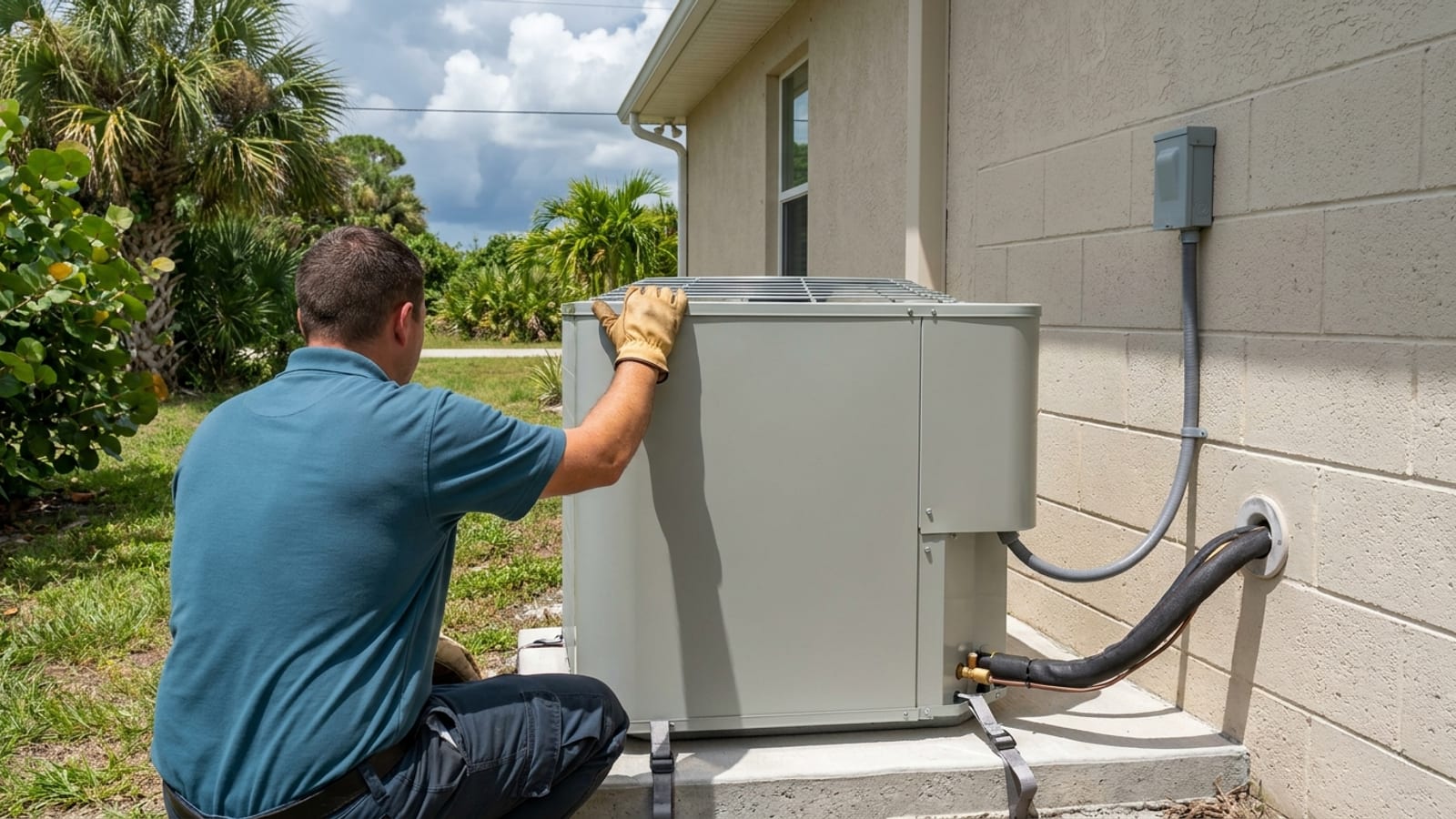
An AC maintenance plan bundles scheduled HVAC visits, usually two each year in Englewood, into one agreement. Depending on its length and repair discount, Florida treats it as either a simple service bundle or a regulated service warranty. The right plan makes care predictable without hiding exclusions, renewal terms, or cancellation rights.
What an AC maintenance plan includes in Englewood
An AC maintenance plan normally organizes recurring visits under one written agreement.
Englewood’s cooling season runs nine months each year. Most local heat pumps also handle the handful of cold mornings each winter. That workload explains why twice-yearly service makes sense here.
The common schedule includes one spring visit and one fall visit. An annual plan can cover both appointments. It may also bring priority scheduling and a repair discount.
Those features shouldn’t be assumed, though. The written agreement controls what the provider actually promises.
Published maintenance pricing runs $89 to $150 per visit, with lower pricing available through an annual plan.
Review the full HVAC maintenance service before comparing agreements. The related AC tune-up service explains the narrower one-visit option.
A plan should answer several basic questions:
- How many visits are included?
- When does the agreement begin and end?
- Which company is selling the agreement?
- What repair discount applies to parts and labor?
- Does the plan include indemnification?
- How does cancellation work?
- Does the agreement renew automatically?
- What happens when emergency service is needed?
Don’t rely on a sales-page summary. Ask for the actual agreement before paying.
An inspection visit and a maintenance agreement aren’t interchangeable. One buys a single appointment. The other creates continuing terms between the buyer and seller.
That distinction becomes especially important under Florida law.
Is an AC maintenance plan worth it in Florida
An AC maintenance plan can be worthwhile when you’d schedule both visits anyway.
The strongest value comes from consistency, priority scheduling, and clear repair terms. The weakest plans make broad promises but leave the important details undefined.
A plan is often a practical fit when:
- You want spring and fall appointments scheduled consistently.
- You value priority scheduling after a breakdown.
- You understand exactly how the repair discount works.
- You plan to keep the system for the agreement period.
- The cancellation language is clear before payment.
Paying per visit may fit better when you want flexibility. It also avoids signing continuing terms you haven’t reviewed.
Homeowners can compare the agreement against a regular Englewood AC maintenance visit. They can also review the cost of an AC tune-up before choosing a recurring arrangement.
Local conditions matter. Salt air can accelerate corrosion on coastal coils. That concern is especially relevant around Manasota Key, Placida, and Cape Haze.
A continuing maintenance relationship can make those coastal inspections easier to schedule. It doesn’t replace careful contract review.
Owners in Rotonda West, Port Charlotte, El Jobean, and North Port face the same agreement questions. The climate changes little across this service area. The legal terms don’t change with the neighborhood.
Snowbird owners should compare the plan with their seasonal schedule. The snowbird AC shutdown checklist covers preparation for an empty home.
The practical decision is simple. Buy a plan when its scheduled service and written protections fit your needs. Choose individual visits when the agreement adds commitments without useful benefits.
When a maintenance plan becomes a regulated service warranty in Florida
Florida uses the plan’s length and terms to determine its legal category.
Part III of chapter 634, Florida Statutes, governs service warranty associations. F.S. 634.401(13) includes a “maintenance service contract equal to or greater than 1 year in length or which does not meet the exemption in paragraph (a)” within its service warranty definition.
That language captures a 12-month AC maintenance plan. It can also capture a shorter agreement that misses the statutory exemption.
The exemption in F.S. 634.401(13)(a) covers “Maintenance service contracts written for less than 1 year which do not contain provisions for indemnification and which do not provide a discount to the consumer for any combination of parts and labor in excess of 20 percent during the effective period of such contract”.
All three exemption conditions work together.
A sub-one-year plan that only bundles visits, contains no indemnification, and keeps any repair discount at 20 percent or less isn’t a regulated service warranty. There is nothing to look up as a service warranty association for that exempt agreement.
A plan lasting one year or longer crosses the statutory line. A shorter plan also crosses it when the repair discount exceeds 20 percent. A plan containing indemnification doesn’t meet the exemption either.
Here is the clean decision framework:
| Agreement term | Florida treatment |
|---|---|
| Less than one year, no indemnification, discount no greater than 20 percent | Meets the maintenance-contract exemption |
| One year or longer | Included within the service warranty definition |
| Less than one year with a repair discount above 20 percent | Doesn’t meet the exemption |
| Less than one year with indemnification | Doesn’t meet the exemption |
Don’t judge the agreement by its marketing name. “Maintenance plan,” “service agreement,” and “maintenance contract” can describe different legal arrangements.
Read the duration first. Then check the repair discount and indemnification language.
F.S. 634.401(13) also excludes service contracts between consumers and condominium associations. That carve-out concerns the parties to the contract, not simply the home’s building type.
What Florida law requires of a regulated plan
A regulated service warranty comes with seller and contract requirements.
F.S. 634.403(1) states: “No person in this state shall provide or offer to provide service warranties to residents of this state unless authorized therefor under a subsisting license issued by the office.”
The office is the Florida Office of Insurance Regulation. The listed exemptions concern authorized insurers and sellers serving only nonresidents.
That section doesn’t establish the status of any particular HVAC provider. It gives buyers a licensing question to check before signing.
The Legislature states its concern directly. F.S. 634.403 says, “The Legislature finds that a violation of this section constitutes an imminent and immediate threat to the public health, safety, and welfare of the residents of this state.”
Florida also requires cancellation language. F.S. 634.414(1) says, “Each service warranty contract shall contain a cancellation provision.”
The same section establishes the holder’s refund floor. It states: “If the contract is canceled by the warranty holder, return of premium shall be based upon no less than 90 percent of unearned pro rata premium less any claims that have been paid or less the cost of repairs made on behalf of the warranty holder.”
That formula concerns the unused portion of the agreement. Paid claims and completed repairs can reduce the refund.
The statute also addresses payment format. “Upon request of the service warranty holder, the refund shall be remitted by check.”
The state doesn’t set the agreement’s price. F.S. 634.414(3) requires “each service warranty contract sold in this state must be accompanied by a written disclosure to the consumer that the rate charged for the contract is not subject to regulation by the office”.
In plain English, Florida licenses the seller and regulates contract requirements. The Florida Office of Insurance Regulation doesn’t set the plan’s rate. The buyer must receive written notice explaining that distinction.
Delivery also has a deadline. F.S. 634.414(4) states, “Each service warranty contract must be mailed, delivered, or electronically transmitted to the warranty holder within 45 days after the date of purchase.”
Keep the agreement after delivery. It contains the terms needed for cancellation, scheduling, discounts, and disputes.
Someone facing a contract dispute should speak with a qualified lawyer. Englewood Air Pro is an HVAC referral service, not a legal adviser.
How to check a plan seller before you sign
Start by identifying the legal company selling the agreement.
The service provider and agreement seller may have different names. Ask which legal entity appears on the contract before paying.
Then review the agreement in this order:
- Find the exact start and end dates.
- Count the scheduled maintenance visits.
- Locate the parts-and-labor discount.
- Check whether the contract contains indemnification.
- Read the cancellation and refund provisions.
- Confirm how and when the contract will arrive.
- Identify the legal seller named on the agreement.
For a regulated plan, use the Florida Office of Insurance Regulation’s public company search at companysearch.floir.gov. Select “SERVICE WARRANTY ASSOCIATION” as the company type and search the seller’s legal name.
Don’t use the lookup to make assumptions about an unnamed provider. Check the company shown on your own agreement.
If the seller’s status remains unclear, ask the provider for clarification. You can also contact the Florida Office of Insurance Regulation directly.
A missing contract should prompt another question. Regulated agreements must be delivered within the statutory period.
Save the sales page, receipt, and delivered agreement together. That creates one record of what was offered and purchased.
Before paying, compare the written terms with the Englewood HVAC service hub. Coastal homeowners can also review options for AC maintenance in Cape Haze.
What a fair plan looks like from the pros we send
A fair plan explains its services, seller, duration, and cancellation terms clearly.
Englewood Air Pro connects homeowners with independently owned and operated licensed HVAC contractors. Every pro we connect you with carries their own license and insurance.
The assigned provider sets availability, pricing, warranties, and service terms. Ask that provider to put every maintenance-plan promise in writing.
Use this checklist during the conversation:
| Ask this question | What the agreement should identify |
|---|---|
| Who sells the plan? | The seller’s exact legal name |
| How long does it run? | Clear beginning and ending dates |
| What service is included? | The number and timing of visits |
| What discount applies? | The stated parts-and-labor percentage |
| Does it include indemnification? | The contract’s own indemnification terms |
| How can I cancel? | The cancellation process and refund language |
| When will I receive it? | The delivery method for the complete contract |
| Who handles repairs? | The provider responsible for scheduling and work |
Watch for verbal promises missing from the agreement. Ask for corrections before accepting the plan.
Priority service should also be defined. Ask whether it affects scheduling during ordinary hours, emergencies, or both.
Englewood Air Pro offers 24/7 emergency referral service across Sarasota and Charlotte counties. Standard hours are Monday through Saturday, 7 a.m. to 7 p.m.
The AC repair service explains how repair requests are handled outside maintenance. A maintenance agreement shouldn’t leave that relationship unclear.
A plan can simplify recurring care. It shouldn’t make the buyer guess about legal status or cancellation rights.
For help connecting with a licensed and insured local HVAC contractor, call Englewood Air Pro at (941) 292-6250. Ask the provider for the complete written agreement before purchasing any recurring plan.
Frequently asked questions
What is an AC maintenance plan?
An AC maintenance plan bundles scheduled service visits into one agreement. In Englewood, the common shape is two visits, priority scheduling, and usually a repair discount.
Is an AC maintenance plan worth it in Florida?
It can be worthwhile when you’d schedule both visits anyway and value priority service. Compare those benefits against the agreement’s duration, discount, and cancellation terms.
Is every AC maintenance agreement a service warranty?
No. A plan under one year can qualify for Florida’s exemption when it has no indemnification and limits its parts-and-labor discount to 20 percent or less.
Can I cancel a regulated service warranty?
Yes. Florida requires each regulated service warranty to contain a cancellation provision and establishes a refund floor based on the unused portion, paid claims, and completed repairs.
How do I check a service warranty seller in Florida?
Use companysearch.floir.gov and select “SERVICE WARRANTY ASSOCIATION” as the company type. Search the exact legal seller named in your agreement before signing.
How much does routine AC maintenance cost in Englewood?
Published maintenance pricing runs $89 to $150 per visit, with lower pricing available through an annual plan. The plan’s complete written terms determine its actual value.