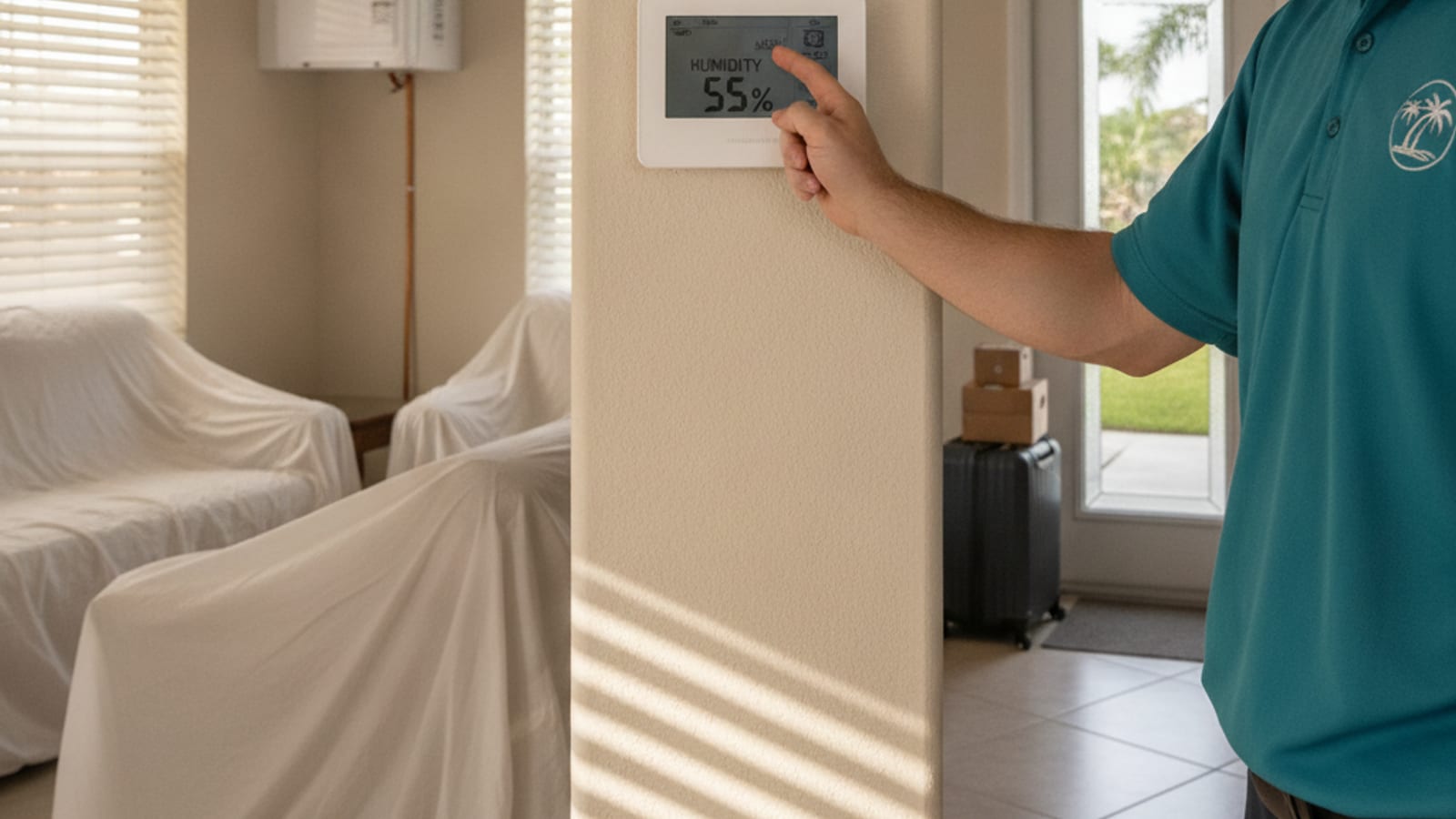
A closed-up house in Englewood without active cooling turns into a mold problem fast. Gulf coast humidity doesn’t take a break just because the owners headed north for the summer, and a home sitting empty for five to seven months a year needs a genuinely different AC plan than a house someone’s living in every day.
The number that actually matters: 55 to 60 percent relative humidity
Most snowbird owners think about their AC in terms of temperature, keeping the house from getting unbearably hot while they’re gone. That’s the wrong target. The number that protects the house is relative humidity, and the goal for a closed-up seasonal home is 55 to 60 percent. Above that range, mold and mildew get a foothold on drywall, cabinetry, and fabric surfaces within days, not weeks, in this climate.
A system set to a high temperature but left to run on a basic schedule doesn’t reliably hold that humidity target, especially during Englewood’s wettest months. Getting humidity control right takes either a system properly sized for dehumidification or a dedicated whole-home dehumidifier working alongside the AC, and it’s worth having a technician confirm your setup can actually hit 55 to 60 percent before you head north for the season.
Remote-monitoring thermostats change the whole equation
A smart thermostat installation is close to essential for anyone leaving an Englewood-area home unoccupied for months at a time. The value isn’t the convenience of adjusting temperature from a phone, it’s the alert. A remote-monitoring thermostat flags when indoor temperature or humidity drifts outside a set range, which means a homeowner in Michigan or Ontario finds out about a failing AC system in hours instead of discovering it as black mold on the baseboards when they fly back in November.
Set the alert thresholds tighter than you’d think necessary. A humidity spike from 58 to 68 percent might not sound dramatic, but caught early it’s a service call. Caught three months later, it’s a full remediation project. Pair the thermostat with a check-in arrangement, a neighbor, a property manager, or the HVAC company itself, so an alert actually triggers someone walking through the door.
Pre-departure shutdown timing
Don’t shut the system off completely and don’t drop straight to a bare-minimum setting the day before you leave. Give the house a transition period. A few days before departure, dial the system toward its away-mode settings gradually rather than abruptly, which lets the HVAC maintenance tech doing your pre-departure check confirm the system is actually holding the target humidity range under real conditions, not just responding well to a fresh setting.
Schedule a professional tune-up in that same pre-departure window every year, not just when something seems off. A coil that’s slightly dirty or a drain line that’s partially clogged won’t necessarily cause a problem in daily-use conditions, but running unattended for months, a marginal issue becomes a full system failure or a drain pan overflow with nobody home to catch it.
Start-up timing when you return
The reverse matters too. Coming back to a home that’s been running in away mode for months, don’t just crank the thermostat down to a comfortable daily setting and assume everything’s fine. Have the system inspected as part of your return routine, checking filters, drain lines, and refrigerant levels before you’re relying on it for daily comfort. A system that’s been quietly struggling for months sometimes doesn’t show it until it’s pushed back to full daily-use demand.
This is also the right time for a broader AC tune-up that checks coil condition and refrigerant charge, especially if your home is anywhere near Manasota Key or another salt-air-exposed area where corrosion accelerates even during months the system was running conservatively.
Indoor air quality during the closed-up months
A house that’s sealed up and running on minimal airflow for months develops different air quality problems than one with regular daily activity and door traffic. Stagnant air, elevated humidity, and reduced filtration cycling all favor mold growth and stale air buildup. A whole-home dehumidifier or an upgraded indoor air quality system does real work here, actively managing humidity and air turnover rather than leaving it to a basic thermostat schedule.
This matters most in older Englewood-area homes with original ductwork or less-than-airtight construction, where humidity infiltration happens faster than a newer, tightly sealed build would experience. If your home falls into that category, ask specifically about a dedicated dehumidifier setup rather than relying on the AC system alone to manage moisture over a long absence.
The hurricane season overlap most snowbirds don’t think about
Most seasonal residents leave the Englewood area in April or May and return in October or November, which means a typical snowbird’s absence lines up almost exactly with hurricane season, running June through November. That timing means a lot of these homes sit unoccupied through the exact stretch of the year when a direct storm hit is most likely, and it’s worth planning for that overlap specifically rather than treating shutdown prep as purely a humidity and mold question.
Confirm your remote-monitoring thermostat and any connected security or leak sensors have a backup connection plan if a storm knocks out local internet or cellular service, since that’s precisely when you’d most want visibility into the house. If a hurricane warning is issued for the area while your home sits empty, having a local contact, whether that’s a property manager, a neighbor, or your HVAC company, who can physically check the property before and after the storm is worth arranging ahead of time rather than scrambling for one once a storm is already approaching. Owners who want the house to keep cooling through an outage should read up on a generator to run AC before the season starts, since the planning has to happen while you’re still here.
FPL account and utility considerations while you’re away
Don’t close your FPL account or drop to a minimal service tier while you’re gone if your AC system needs to keep running to protect the house. This sounds obvious, but it’s a genuine mistake some seasonal owners make trying to save on utility costs during their absence, not realizing that a functioning AC system depends on uninterrupted power. If you’re on a budget billing plan or considering any account changes before departure, confirm directly with FPL that your service level supports continuous operation of your away-mode HVAC settings for the full absence.
It’s also worth setting up account alerts for unusual usage spikes or drops, since a sudden change in electricity consumption while you’re away can be an early signal that something’s wrong with the system, sometimes catching a problem even before your thermostat’s own humidity or temperature alerts do.
What a realistic seasonal maintenance plan looks like
A snowbird-specific service plan usually includes two visits a year timed around departure and return, remote monitoring with alert thresholds set for an empty house rather than daily occupancy, and a humidity target confirmed at 55 to 60 percent rather than left to a default thermostat setting. Ask any HVAC company you’re considering whether they specifically service seasonal, unoccupied homes, since the maintenance priorities are genuinely different from a full-time resident’s routine.
What humidity level should I set my thermostat to before leaving for the season?
Target 55 to 60 percent relative humidity, not just a temperature setting. That range prevents mold and mildew growth in a closed-up home without running the system harder than necessary while nobody’s there.
Do I need a smart thermostat if I’m only gone a few months?
For any absence of a month or longer in this climate, yes. A remote-monitoring thermostat is what turns a slow AC failure into a same-week service call instead of a discovery made months later when you return.
Should I turn my AC off completely while I’m away?
No. Turning the system off entirely lets humidity climb well past safe levels within days in this climate. The system should keep running in a dedicated away mode that holds temperature and humidity within a safe range.
How often should a snowbird home get professional AC service?
Twice a year is a reasonable baseline, timed around departure and return, so a technician confirms the system is actually holding its target settings both before you leave and before you’re relying on it again for daily comfort.
If you’re prepping your Englewood-area home for a long absence or you’re back and want the system checked before you settle in for the season, call (941) 292-6250 and we’ll connect you with a local pro who handles seasonal shutdown and start-up service.