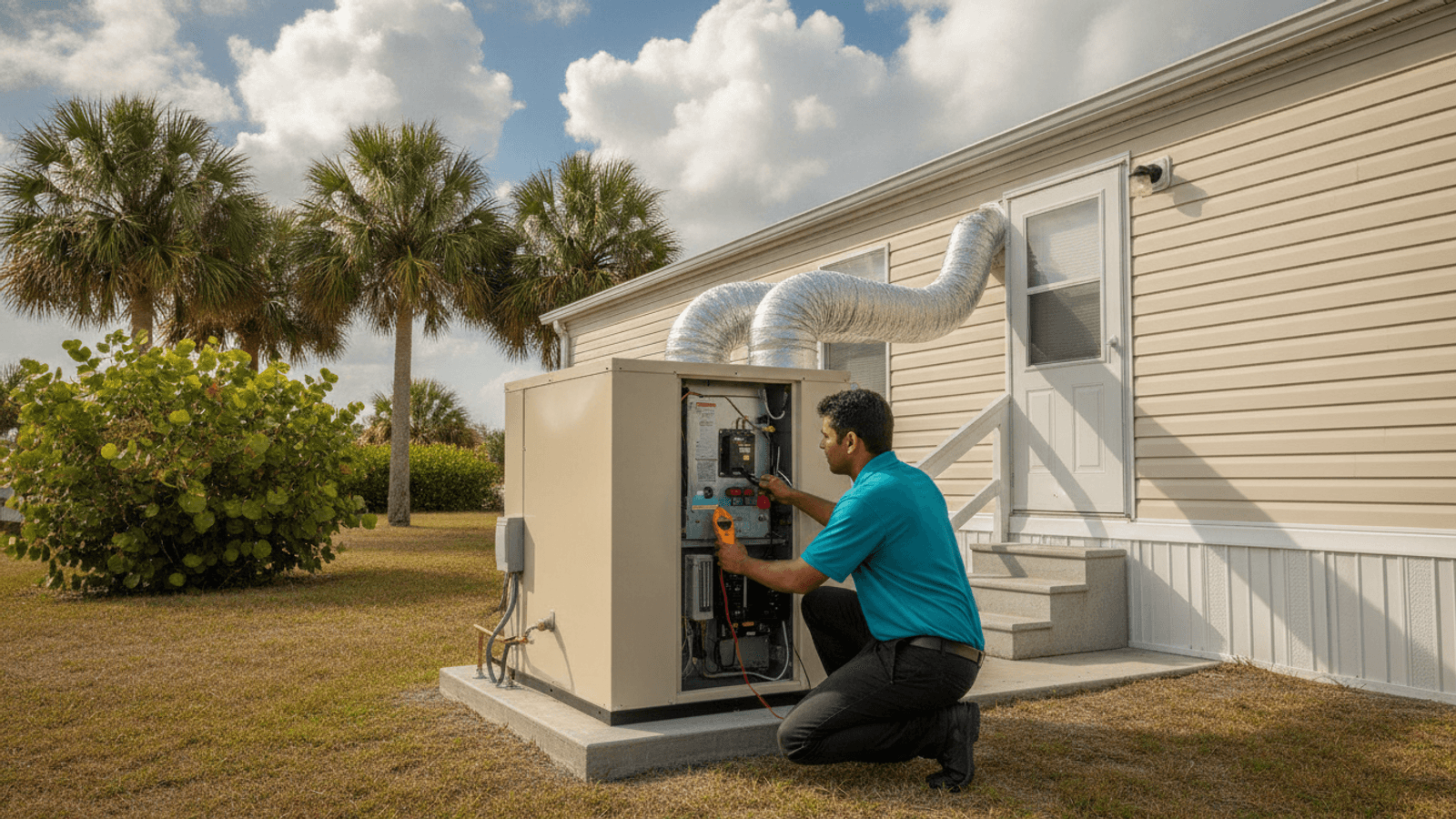
Mobile home AC repair starts with equipment compatibility, not a bigger replacement. Manufactured homes use different furnaces, coils, air handlers, and packaged systems. The home also carries a Comfort Cooling Certificate showing the duct system’s maximum AC capacity. A licensed HVAC pro should read that certificate before recommending equipment.
What makes mobile home AC repair different?
Mobile home AC repair requires equipment matched to the home’s original design. A standard residential air handler isn’t automatically a suitable replacement.
Charlotte County has many mobile and manufactured homes. They’re especially common around Harbour Heights, Deep Creek, and El Jobean. These homes often use smaller packaged systems that differ from site-built setups.
A packaged system combines major heating and cooling components in one cabinet. Other manufactured homes pair an indoor coil with a dedicated furnace. Either arrangement requires careful compatibility checks before replacing major components.
Federal standards also address how this equipment must be matched. Cooling equipment must be listed or certified for its intended application. Indoor coils and outdoor sections must be listed and rated together.
The pros we send inspect the existing configuration before recommending an AC repair service. That inspection helps separate a repairable component from a mismatched system.
Where can you find the home’s cooling certificate?
The Comfort Cooling Certificate is permanently attached inside the manufactured home. Federal rules require it to remain readily visible to the occupant.
The certificate contains information specific to that individual home. Never rely on an assumed capacity or a neighborhood comparison. Find the certificate and read the printed wording before discussing replacement equipment.
HUD’s certificate provides three possible cooling configurations:
| Certificate version | What the wording tells you |
|---|---|
| Alternate I | The home received factory-installed air conditioning and lists its certified capacity. |
| Alternate II | The duct system supports central air conditioning up to the printed Btu/h capacity. |
| Alternate III | The duct system wasn’t designed for central air conditioning. |
Alternate II contains a blank completed for that particular home. Its wording says the supply air system supports central cooling up to the printed Btu/h capacity. That number belongs to the home and shouldn’t be estimated.
Alternate III requires a different conversation. Its wording states that the air distribution system wasn’t designed for central air conditioning. That home isn’t facing a simple equipment swap.
Why can’t a replacement system simply be larger?
Federal installation standards cap the system according to the home’s certificate. Under 24 CFR 3285.503, site-installed AC capacity cannot exceed the duct system’s rated capacity shown there.
The same standard requires equipment sized for the home’s heat gain. Bigger equipment isn’t automatically better in Englewood’s hot, humid climate.
An oversized system can cool the air too quickly. It then shuts off before removing enough indoor moisture. The rooms may feel cool while remaining damp and uncomfortable.
The certificate protects against guessing based only on Florida heat. It gives the contractor a home-specific ceiling for equipment selection.
Alternate II also references air circulators rated at 0.3-inch water-column static pressure or greater. That condition makes the equipment and duct pairing important. Mobile-home-rated air handlers and packaged units exist for these distinct configurations.
If replacement becomes necessary, request a matched mobile home AC installation assessment. The assigned provider should compare every recommendation against the home’s certificate.
Can a standard residential coil fit a mobile home furnace?
A standard residential coil isn’t automatically compatible with a mobile home furnace. The coil must be listed for use with that furnace.
Federal standard 24 CFR 3285.503 requires A-coil compatibility with the home’s furnace. Installation must also follow the appliance manufacturer’s instructions.
Federal standard 24 CFR 3280.714 adds another matching requirement. Indoor coils and outdoor sections must be certified, listed, and rated together.
These rules matter when one major component fails before another. Replacing only the failed component may appear simpler. However, the remaining equipment still has to form an approved combination.
Ask the technician to identify the existing furnace, coil, and outdoor equipment. Those labels help the provider check whether a compatible repair remains available.
What does mobile home AC repair cost?
A diagnostic visit costs $89 to $150. Most AC repairs cost $150 to $650, depending on the problem.
A manufactured-home or package-unit replacement typically costs $3,500 to $8,000. The home’s age and existing setup affect where the quote falls.
| Service need | Published range |
|---|---|
| Diagnostic visit | $89 to $150 |
| Most AC repairs | $150 to $650 |
| Manufactured-home or package-unit replacement | $3,500 to $8,000 |
Availability, pricing, warranties, and service terms come from the assigned provider. An accepted written quote is the authoritative price for the work.
Our Englewood AC repair cost guide explains general repair pricing in more detail. It also helps homeowners prepare questions before approving work.
When could the ductwork be causing the problem?
Look under the home first. A manufactured home’s supply ducts run in the belly, beneath the floor, feeding registers in the floor rather than the ceiling.
That location is why these duct problems look nothing like a site-built home’s. The trunk hangs under the floor, exposed to ground moisture, animals, and anything that snags it.
If the home is a double-wide, there’s one more part worth knowing about. The federal installation standard puts it plainly: multi-section homes with ductwork in more than one section require crossover connections to complete the duct system. That crossover is a single duct joining the two halves.
When a crossover duct tears loose or falls, one half of the home stops cooling while the equipment keeps running normally. Homeowners often read that as a dying AC when the actual failure is a disconnected duct lying on the ground.
The same standard requires ducts to be suspended or supported above the ground by straps spaced no more than four feet apart, and requires every connection, including duct collars, to be sealed against air leakage. A crossover sagging onto the dirt between widely spaced straps is a visible, fixable problem.
Our ductwork repair service covers sealing, damaged sections, and airflow problems. The Englewood ductwork repair cost guide explains when spot repairs differ from larger duct projects.
Homeowners near El Jobean should mention whether their system is packaged. That detail helps the assigned provider prepare for the correct configuration.
Which Florida license applies to the HVAC work?
Mobile home AC work requires an HVAC contractor with a Florida CAC license. A mobile home installer license is a different credential.
Florida mobile home installer licensing covers setup operations. Those operations include positioning, blocking, leveling, supporting, tying down, and utility connections. That credential doesn’t authorize HVAC repair or replacement work.
You can verify a contractor’s active CAC license at myfloridalicense.com. Englewood Air Pro is a referral service, not the licensed contractor. Every pro we connect you with carries their own license and insurance.
Permit requirements can depend on the property’s county and project scope. Ask the assigned contractor what applies before approving replacement work. Our Englewood AC replacement permit guide explains the local county split without replacing that project-specific check.
What should you check before the technician arrives?
Start by finding the home’s Comfort Cooling Certificate. Photograph the full certificate so every line remains readable.
Then collect the model labels from accessible equipment. Include the furnace, indoor coil, outdoor unit, or packaged cabinet. Don’t remove panels or enter unsafe areas to obtain them.
Write down what the system does before it stops working. Note weak airflow, short cycles, unusual moisture, or rooms that stay warm. These observations help the technician narrow the initial inspection.
Share any previous repair records with the assigned provider. If the system still operates, scheduling HVAC maintenance can also uncover developing airflow or moisture concerns.
Frequently asked questions
How do I find the correct AC size for my mobile home?
Read the Btu/h capacity printed on the home’s Comfort Cooling Certificate. That home-specific number caps the central AC capacity supported by its duct system.
A contractor should also size equipment for the home’s heat gain. The certificate provides a ceiling, not permission to guess.
What does Alternate III mean on the cooling certificate?
Alternate III means the duct system wasn’t designed for central air conditioning. The home isn’t ready for a straightforward central AC change-out.
A licensed HVAC pro should inspect the complete configuration. The recommendation must account for the home’s actual air distribution design.
Can a standard residential air handler replace my current unit?
Not automatically. The replacement must be listed for its intended application and compatible with the connected equipment.
The home’s certificate and existing component labels guide that review. A familiar cabinet size alone doesn’t establish compatibility.
Do I need a mobile home installer for AC repair?
No mobile home installer license substitutes for an HVAC license. HVAC work requires a contractor holding the appropriate Florida CAC license.
The two credentials cover different work. You can verify the HVAC contractor’s CAC status at myfloridalicense.com.
Should I repair or replace an older mobile home AC system?
Begin with a diagnostic inspection and an equipment compatibility check. A repair may work when compatible components remain available.
Replacement requires reviewing the certificate, duct capacity, and matched equipment. Our guide to AC system lifespan in Englewood covers the broader age and condition factors.
Get matched with a licensed mobile home AC pro
Englewood Air Pro connects homeowners with licensed and insured local HVAC providers. The pros we send can inspect mobile-home equipment, certificates, and duct configurations.
Call (941) 292-6250 to request mobile home AC repair in Englewood.