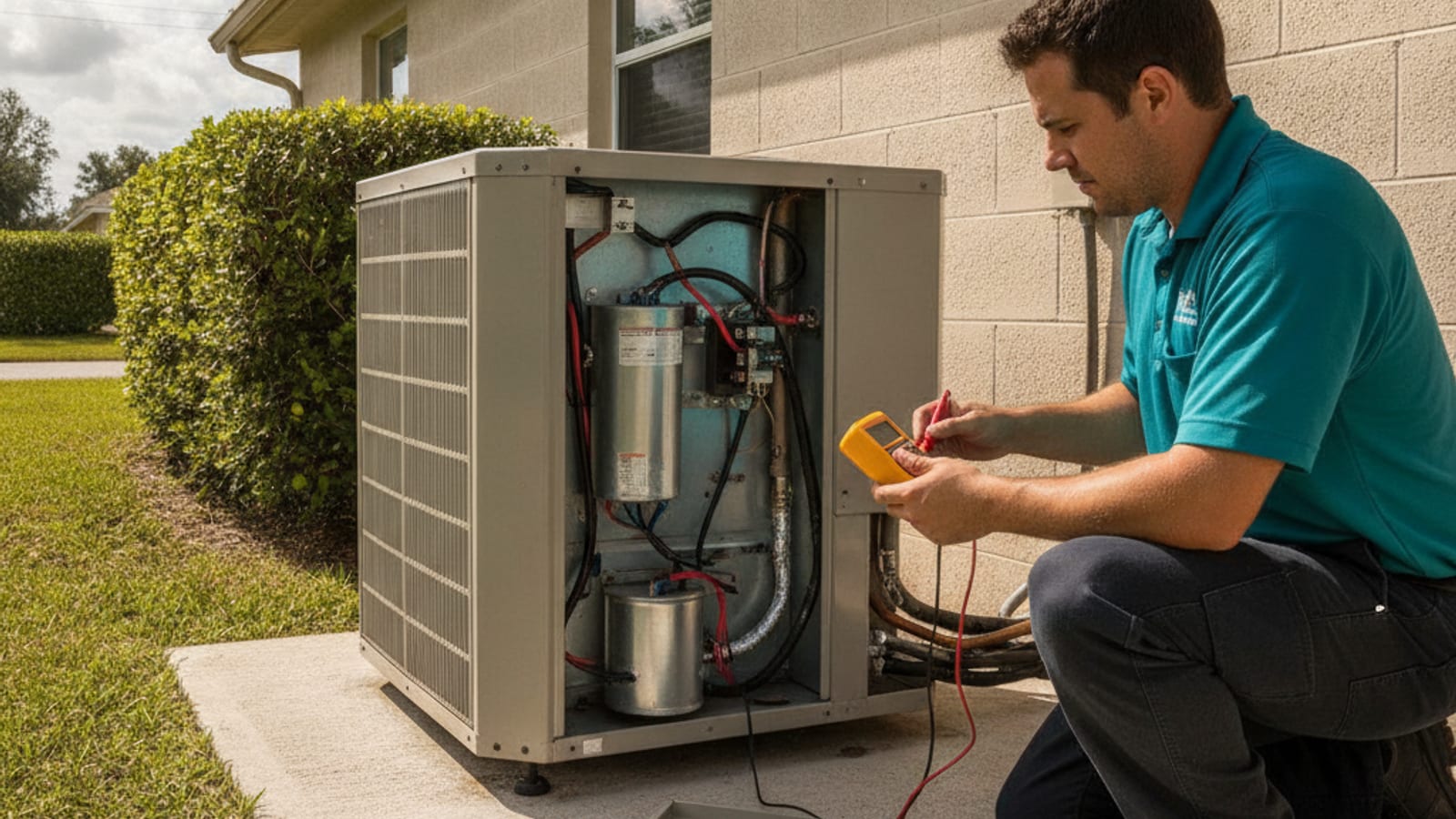
Most AC repairs in Englewood run $150 to $650 for parts and labor, on top of an $89 to $150 diagnostic fee. A weak capacitor sits at the low end. A refrigerant leak or a failed motor runs higher. The exact number depends on what’s actually broken, which is why a real diagnostic comes before any quote.
Englewood Air Pro connects homeowners across Sarasota and Charlotte counties with local HVAC pros for AC repair, with free quotes and every visit starting with a written price before any work begins. Here’s what actually drives the cost up or down.
What does AC repair typically cost in Englewood?
A standard diagnostic runs $89 to $150 and covers a full check with gauges and a multimeter, not a guess. Once the technician finds the actual problem, most repairs land between $150 and $650. Capacitors and contactors, the parts behind most no-cool calls in this climate, sit at the low end of that range. Refrigerant leak repairs and motor replacements run closer to the top, since they involve more labor and pricier parts. Heat pump repairs follow a similar pattern: most run $150 to $650, while a reversing valve or inverter board replacement runs $400 to $900 given how much more involved that repair is.
Why does the diagnostic fee come before the repair price?
A phone quote for AC repair is a guess, not a price. Two systems that both “blow warm air” can have completely different problems underneath, a dead capacitor in one case and a slow refrigerant leak in the other, and those repairs cost very different amounts. The diagnostic fee pays for an actual technician to test the system with real instruments and identify the failure before anyone commits to a number. You get the repair quote in writing before the technician touches anything else.
What’s the difference between a cheap fix and an expensive one?
Capacitors and contactors are small, relatively inexpensive parts that fail often in a climate where the AC runs nine months a year, which is why they anchor the low end of the repair range. A frozen evaporator coil usually points to restricted airflow or low refrigerant charge rather than a single cheap part, and fixing the underlying cause, whether that’s a dirty filter, a failing blower motor, or a slow leak, determines where the final bill lands. Refrigerant leak detection and recharge, plus fan motor, blower motor, or control board replacement, sit at the higher end because the parts and labor both cost more.
Does Englewood’s climate make AC repairs more frequent?
Yes, in a couple of specific ways. A nine-month cooling season means the system logs far more run hours here than a comparable unit up north, and that workload wears out capacitors, contactors, and blower motors faster. Homes near the water in Manasota Key and Boca Grande see an added factor: salt air corrodes condenser coils, fins, and electrical connections years before it would fail further inland, which shows up as more frequent coil-related and electrical repairs on coastal calls. In Port Charlotte and Punta Gorda, we still see repairs on systems with corroded terminals or coil damage tied back to Hurricane Ian’s flooding, years after the storm itself.
Does repair cost or availability change during peak season?
Some, mostly on the scheduling side rather than the price itself. Diagnostic and repair pricing stays the same year-round, but call volume spikes hard once the first stretch of 90-degree days hits, and emergency no-cool calls start competing for the same appointment slots as routine repairs. A capacitor that’s drifting toward failure in March is a same-week fix. The same part failing outright in late July often means a longer wait unless it’s dispatched as a true no-cool emergency. Scheduling a spring AC tune-up ahead of that rush is the more predictable way to avoid getting stuck in the July backlog entirely.
Is it ever cheaper to replace the system instead of repairing it?
Sometimes. Once a system passes 12 years old and needs a major repair, a full AC installation often makes more financial sense than sinking more money into aging equipment. A technician can walk through that comparison honestly during the diagnostic visit rather than defaulting to whichever option is easier to sell.
What should you check before calling for repair?
A few signs point clearly to a repair call rather than a wait-and-see approach: the system runs but blows warm air, ice has formed on the refrigerant lines or indoor coil, a breaker trips every time the AC starts, water is pooling near the indoor unit, or the outdoor fan hums but won’t spin. An electric bill that jumped with no real change in how you’re running the AC is a quieter sign worth paying attention to as well, since a system losing refrigerant or fighting restricted airflow often runs longer to hit the same setpoint before anyone notices the house feels warmer. Shutting the system off once you spot one of these, rather than letting it keep running, usually keeps a small problem from turning into a bigger one.
The ranges above are for site-built homes. If you’re in a mobile or manufactured home, the equipment and the sizing rules are different enough that we split it out in our guide to mobile home AC repair in Englewood.
Regular HVAC maintenance catches a lot of these issues, like a drifting capacitor reading, before they turn into a no-cool emergency in the middle of summer. For homes closer to the coast, our post on protecting AC equipment from salt air covers what accelerates corrosion-related repairs specifically. If your system has been flagged during an insurance inspection, our 4-point inspection guide explains what adjusters actually look for.
Frequently asked questions
How much does an AC repair diagnostic cost in Englewood?
The diagnostic visit runs $89 to $150 and includes a full check of the system with gauges and a multimeter rather than a visual guess. That fee applies toward understanding the actual problem before any repair work starts, and you get a written repair quote before the technician goes further.
What’s the most common AC repair in Englewood?
Capacitor and contactor failures account for a large share of no-cool calls here, largely because the system runs close to year-round and those parts wear out under that kind of continuous load. Both are relatively quick, lower-cost repairs compared to a refrigerant leak or motor replacement.
Why do AC repair costs vary so much between homes?
The part that failed and how much labor the fix takes are what set the price. A capacitor swap takes far less time and a cheaper part than tracing and sealing a refrigerant leak or replacing a blower motor, so the final bill reflects that difference rather than a flat rate for every call.
Can salt air make AC repairs cost more near the coast?
Yes. Homes in Manasota Key, Boca Grande, and other coastal spots see condenser coils and electrical connections corrode faster than homes further inland, which leads to more frequent coil cleaning, connection repair, and corrosion-related service calls over the life of the system.
Does a home warranty cover AC repair costs in Englewood?
That depends entirely on your specific policy, its coverage limits, and its list of excluded parts, so it’s worth calling your warranty provider directly before assuming what’s covered. We can still send a technician for a diagnostic and written quote regardless of whether a warranty ends up applying.
How do I know my AC repair technician is actually licensed?
Florida requires a CAC, air conditioning contractor, license for anyone performing HVAC repair work, and you can verify any contractor’s license status for free at myfloridalicense.com before work starts. We connect Englewood homeowners with experienced, insured local HVAC pros, and we’d rather you check the license yourself than take anyone’s word for it, ours included. If you’re weighing a cheaper offer instead, here’s where handyman AC repair crosses Florida’s legal line.
If your AC needs a look, call (941) 292-6250 and we’ll connect you with a local HVAC pro who diagnoses the actual problem and quotes it in writing before any repair starts.