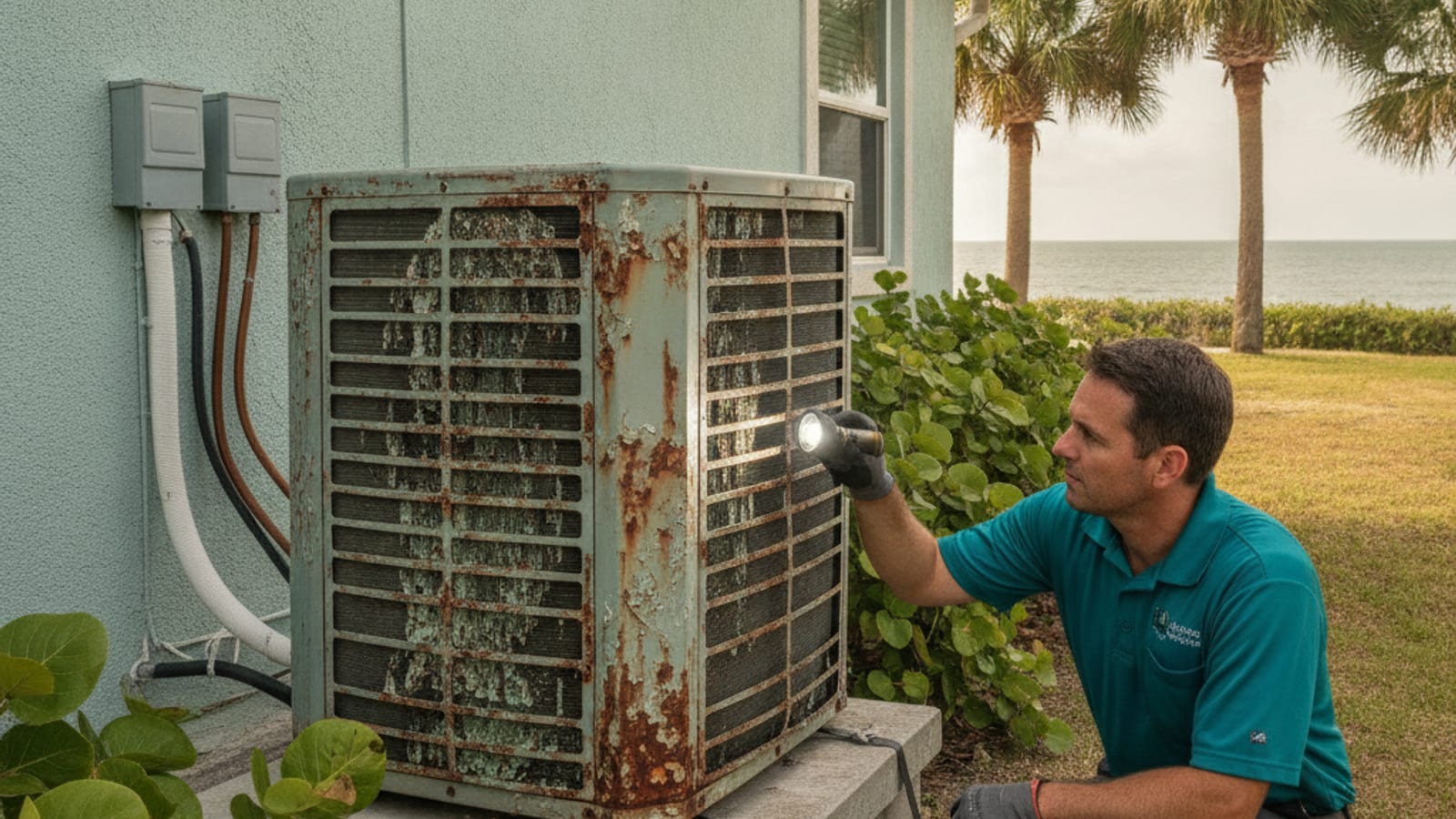
An AC condenser that runs fifteen years on a mainland Port Charlotte lot can start showing real corrosion in five on Manasota Key or Boca Grande. Salt air isn’t just a slightly harsher version of regular Florida humidity, it’s a genuinely different environment, and it changes which equipment choices actually make sense once you’re within a mile or two of the Gulf.
Why salt air is a different problem than heat or humidity
Standard Florida humidity is already hard on outdoor equipment. Salt air adds a corrosive layer on top of that, and it targets metal specifically: condenser coils, fan blades, electrical contacts, cabinet screws, anything with an exposed metal surface sitting outside year-round.
The mechanism is straightforward chemistry. Salt particles carried in Gulf air settle on metal surfaces, and combined with humidity, they accelerate oxidation well beyond what the same metal experiences a few miles inland. A standard aluminum condenser coil that would last a decade or more in inland Sarasota County can show visible pitting and reduced efficiency within a few years on a Gulf-front property.
Which parts fail first
Condenser coils take the brunt of it, since they’re the largest exposed metal surface and they sit outdoors permanently. Fin corrosion reduces airflow across the coil, which drops cooling efficiency and forces the compressor to work harder just to hit the same temperature. Electrical contacts and control board components inside the outdoor unit’s cabinet are the second failure point, since salt-laden moisture works into connections that a standard cabinet doesn’t fully seal against. A corroded connection that starts overheating is one way a burning smell from an air conditioner starts on a coastal system.
Fasteners and cabinet panels corrode too, and while that’s more cosmetic than functional at first, a rusted-through panel eventually lets more moisture into places it shouldn’t reach. On barrier-island properties, techs regularly find outdoor units with heavy visible corrosion on a system that’s only four or five years old, well short of the twelve-to-fifteen-year life a standard install would expect on the mainland.
Coated coils versus standard equipment
Manufacturers make coastal-rated equipment specifically for this environment, and the coils are the main difference. A coated or coastal-rated coil has a protective finish, often epoxy or a similar polymer coating, applied over the aluminum fins and copper tubing. That coating doesn’t stop corrosion completely, but it slows it enough to meaningfully extend equipment life in direct salt exposure.
For any AC installation within roughly a mile of the Gulf, coastal-rated equipment is worth the upfront cost difference. Standard residential equipment is engineered and warrantied for typical suburban exposure, not barrier-island salt air, and installing it on Manasota Key or Boca Grande without the coastal upgrade usually means a shorter service life and more frequent repair calls than the homeowner expected going in.
A rinse-down maintenance schedule that actually matters here
Rinsing salt residue off an outdoor condenser with fresh water is one of the simplest, cheapest things a barrier-island or near-coastal homeowner can do to extend equipment life. A monthly rinse, more often during peak salt-spray conditions like a windy dry stretch, washes away accumulated salt before it has time to fully bond with the metal and accelerate corrosion.
This matters more here than almost anywhere else in the metro. A condenser on Boca Grande or Manasota Key sits in near-constant Gulf air exposure, while the same equipment a few miles inland in mainland Englewood sees a fraction of the salt load. Pairing a rinse-down routine with a scheduled AC tune-up that includes a real coil inspection catches early corrosion before it becomes a refrigerant leak or a failed compressor.
What this looks like across different island and coastal properties
On Boca Grande, where properties sit directly on Gasparilla Island with full Gulf exposure on most lots, techs specify coastal-rated equipment as close to a default as this metro gets. The historic village’s affluent, seasonal-occupancy housing stock generally supports the equipment upgrade cost, and given how far techs have to travel for a service call here, homeowners tend to prioritize equipment that won’t need frequent attention.
On Palm Island, reached only by a short car ferry from Placida, the same salt exposure applies, but the ferry-dependent logistics add another reason to favor durable, coastal-rated equipment over standard gear that needs more frequent servicing. A repair visit here means scheduling around ferry times, not just a tech’s drive time.
On Manasota Key, a narrower barrier island split between Sarasota and Charlotte counties, salt exposure is severe on Gulf-facing lots and noticeably less intense on the bay side, so equipment specification reasonably varies block to block depending on which side of the island a home sits on.
Interior comfort isn’t the risk, the outdoor unit is
It’s worth being clear about where the real risk concentrates. Indoor air handlers, ductwork, and interior components don’t face meaningfully accelerated salt-air wear, since they’re never exposed to outdoor air directly. The corrosion risk is almost entirely about the outdoor condenser and any exposed refrigerant lines or electrical conduit running to it. That’s useful context when a homeowner is deciding where to spend extra on coastal-rated components and where standard equipment is perfectly fine.
Placement and orientation matter almost as much as the coating
Where a condenser sits on the property and which direction it faces changes its real-world exposure even with identical coastal-rated equipment. A unit placed on the Gulf-facing side of a home, directly in the path of prevailing onshore wind, takes a heavier and more constant salt load than the same unit tucked behind the house or shielded by a wall, fence, or dense landscaping.
When a full AC repair or replacement is already on the table, it’s worth asking the contractor whether relocating the condenser to a more sheltered spot on the property is practical. It isn’t always possible given plumbing and electrical routing, but on a barrier-island lot with flexibility in the layout, a shielded placement can meaningfully extend equipment life beyond what the coating alone provides. A simple wind screen or louvered enclosure built specifically for HVAC equipment can offer a similar benefit for units that can’t be relocated, as long as it doesn’t restrict the airflow the condenser needs to actually function.
Elevation and flood risk add a second layer to the placement decision
Barrier-island and canal-front properties often face flood-zone requirements that push equipment placement decisions beyond salt exposure alone. Condensers on these lots frequently sit on raised stands or platforms to keep them above expected storm-surge and flood levels, which is a separate but related consideration from salt-air corrosion. A contractor specifying equipment for a Gulf-front or canal-front property should be addressing both the coastal-rated equipment question and the elevation requirement together, since a coated coil sitting in floodwater during a storm surge event faces a different kind of failure than gradual salt corrosion.
What to ask an installer before committing
For any new install within a mile or two of the Gulf, ask directly whether the equipment being quoted is coastal-rated or standard residential-grade. Ask what the manufacturer’s warranty covers in a documented salt-air environment, since a standard warranty sometimes has exclusions for coastal corrosion that a coastal-rated unit’s warranty doesn’t carry. And ask about the recommended rinse-down interval for your specific property’s exposure level, since a Gulf-front Boca Grande estate and a bay-side Manasota Key cottage face genuinely different conditions even a few hundred yards apart.
Why does AC equipment corrode faster on barrier islands than inland?
Salt particles carried in Gulf air settle on metal surfaces and accelerate oxidation well beyond what the same metal experiences a few miles inland. Standard aluminum coils and cabinet components can show real corrosion within four or five years on a barrier-island property, compared to a decade or more inland.
Is coastal-rated equipment worth the extra cost?
For any install within roughly a mile of the Gulf, yes. The coating on a coastal-rated coil slows corrosion enough to meaningfully extend service life, and the equipment is warrantied for the environment it’s actually operating in.
How often should I rinse my outdoor AC unit near the coast?
Monthly is a reasonable baseline for a barrier-island or immediate coastal property, more often during a windy, dry stretch when salt spray accumulates faster than usual. A quick rinse with a garden hose is enough, no chemicals needed.
Do indoor components need the same salt protection as the outdoor unit?
No. Indoor air handlers, ductwork, and interior components never see direct outdoor air exposure, so they don’t face the same accelerated corrosion. The real risk is concentrated on the outdoor condenser and any exposed lines or conduit.
If you’re dealing with a corroding outdoor unit or planning a new install anywhere near the Gulf, call (941) 292-6250 and we’ll connect you with a local HVAC pro who specs the right equipment for your exact exposure level.