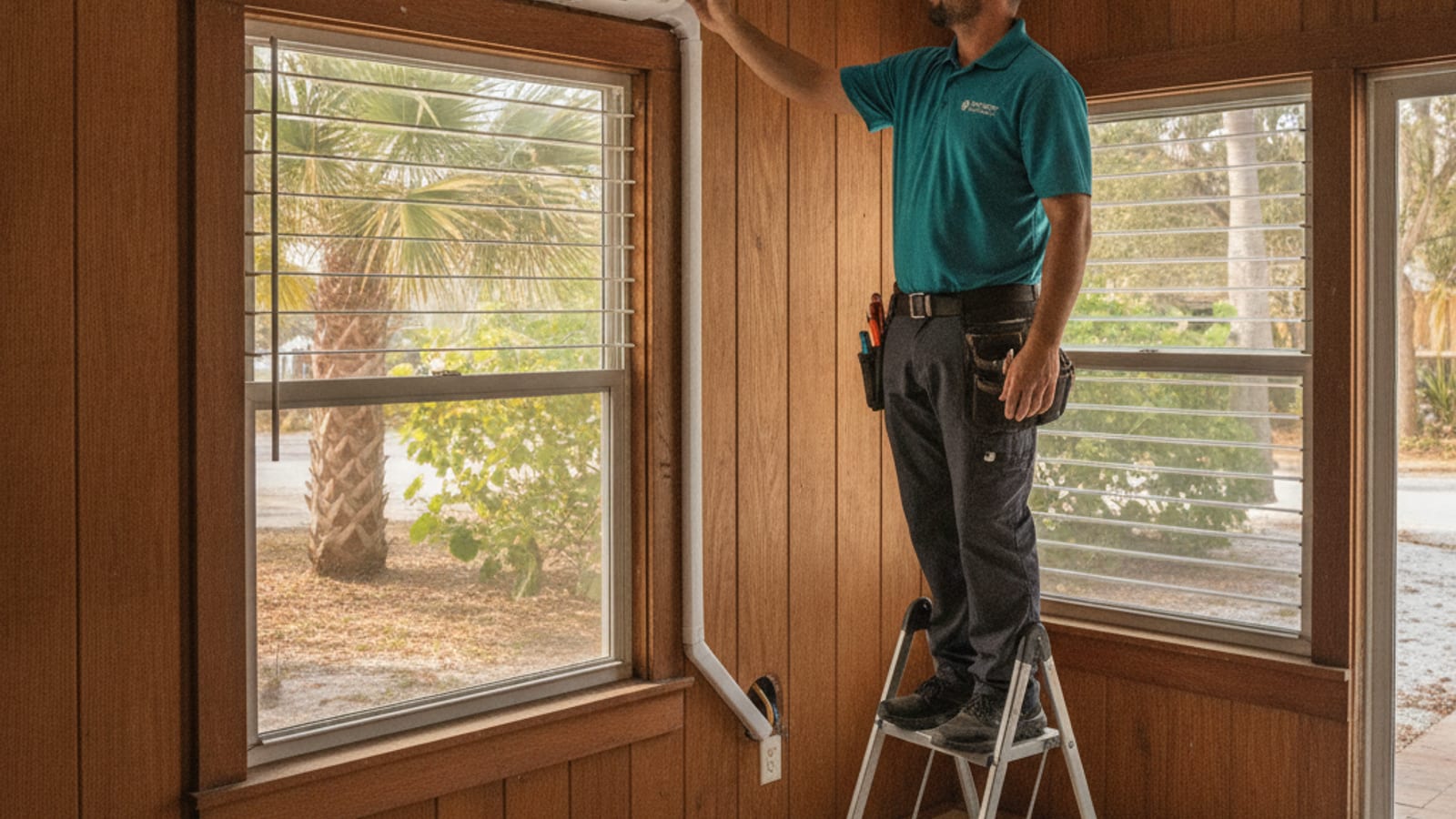
Englewood Core and Placida still hold a real number of pre-1960s cottages, small, original Gulf-coast homes built decades before central air conditioning was standard. Retrofitting full ductwork into a house that was never designed for it is expensive, invasive, and sometimes structurally impractical. That’s exactly the gap mini split systems were built to fill.
Why these cottages never got proper ductwork
A house built in the 1940s or 1950s in this area was designed around window units, ceiling fans, and Florida cracker-style ventilation, not a central forced-air system. Retrofitting ductwork into that kind of construction means finding space for supply and return runs in a house with low attic clearance, no chase cavities built into the walls, and a floor plan that predates the idea of a central mechanical closet. Some owners have managed it over the decades, usually at real cost and with compromises like exposed soffits or reduced ceiling height in hallways. Plenty of others simply never did, and have lived with window units or an undersized attempt at central air that never quite worked right.
Additions present the same problem in a smaller way. A lanai enclosure, a Florida room, or a garage conversion built onto an older cottage rarely ties cleanly into the original home’s ductwork, if that ductwork even exists, which leaves that added space either uncooled or served by a struggling extension of an already inadequate system.
What a mini split actually solves here
A mini split installation sidesteps the ductwork problem entirely. An outdoor compressor connects to one or more indoor wall or ceiling-mounted units through a small refrigerant line set that runs through a modest wall penetration, no attic ductwork required. For a cottage that was never built for ducts, this is often the only practical way to get real central-air-quality comfort without a structural renovation.
Zone-by-zone control is the other major advantage. Rather than one system trying to cool an entire house through a single duct network, each mini split indoor unit controls its own zone independently. That’s a meaningful upgrade for additions and lanais specifically, since a homeowner can run a mini split zone hard in a sunroom that gets brutal afternoon heat while keeping a shaded back bedroom at a more moderate setting, something a single central system simply can’t do as precisely.
Humidity performance compared to an oversized central system
This matters more in Florida than the zone-control convenience alone. When a central system does get shoehorned into a small older cottage, it’s frequently oversized relative to the home’s actual square footage, since contractors sometimes default to a standard minimum-capacity unit that’s still too large for a genuinely small house. An oversized AC unit cools the air fast without running long enough in each cycle to properly remove humidity, leaving a home that reads cool on the thermostat but feels damp and clammy, exactly the kind of environment that invites mold in a Gulf-coast climate.
Mini splits, sized correctly per zone rather than for a whole house at once, tend to avoid this problem. Because each indoor unit is matched to the specific room or area it serves, the system runs cycles proportional to that space’s actual cooling and dehumidification need, which generally produces better humidity control than an oversized central retrofit crammed into a house too small for it.
What this looks like in Englewood Core and Placida specifically
In Englewood Core, the original coastal village area with the highest concentration of pre-1960s cottage construction in the metro, mini splits have become a common recommendation for owners renovating or simply upgrading from window units. The housing stock here skews small and older, and full ductwork retrofits are often cost-prohibitive relative to the home’s value, which makes mini splits the more economically sensible path to real central-air comfort.
Placida, just west toward the Lemon Bay and Gulf side, carries a similar profile, with quiet residential streets of older Gulf-coast homes that share the same no-ductwork reality as greater Englewood’s core. Homeowners here weighing a full renovation against a targeted mini split install often find the mini split route delivers comparable comfort at a fraction of the disruption and cost.
Cost and disruption comparison
A full ductwork retrofit into an older cottage typically means opening walls or ceilings, potential structural work to create chase space, and weeks of disruption to a small home where there’s often nowhere else in the house to retreat to during construction. A mini split installation, by comparison, generally takes a matter of days per zone, with far less structural intervention, since the only penetration needed is a small hole for the refrigerant line set and drain.
For an owner planning to add zones over time, a room-by-room mini split rollout is also easier to budget incrementally than committing to a full-house ductwork project all at once.
Single-zone versus multi-zone systems
A single-zone mini split serves one indoor unit off one outdoor compressor, which suits a single-room addition, a garage conversion, or a lanai enclosure being cooled independently of the main house. A multi-zone system connects multiple indoor units to a single outdoor compressor, which makes more sense when covering several rooms or an entire small cottage, since it consolidates outdoor equipment to one unit instead of several separate compressors cluttering the exterior of a small property.
The tradeoff is flexibility versus efficiency. A multi-zone system generally costs less upfront than installing several single-zone systems separately and takes up less exterior space, which matters on a small cottage lot where yard space is already tight. But a single-zone setup gives each area fully independent operation with no shared compressor capacity, which can matter if one zone, like a sun-drenched Florida room, needs to run harder than the rest of the house on a regular basis. A contractor should walk through both configurations for your specific cottage layout rather than defaulting to whichever is easier to quote.
Filter maintenance is simpler, but it’s still required
One underappreciated advantage of a mini split system is how straightforward filter maintenance becomes compared to a central system’s less accessible return-air filter. Each indoor unit has its own washable filter, typically accessible by opening the unit’s front panel, and manufacturers generally recommend checking and cleaning it every few weeks during peak cooling season in a humid climate like this one.
That accessibility is a genuine benefit, but it only helps if homeowners actually follow through. A neglected mini split filter reduces airflow and dehumidification performance just like a neglected central-system filter does, so building the habit into a regular household routine matters even though the mechanical part of the maintenance itself is simple.
When ductwork retrofit still makes sense
Mini splits aren’t the right call in every case. A cottage undergoing a full gut renovation with walls already open for other reasons sometimes makes sense as a ductwork retrofit opportunity, since the structural barrier that normally rules ductwork out has already been removed for other work. It’s worth discussing both options with a contractor before committing, particularly if a larger renovation is already planned.
Can a mini split really replace central air in an older cottage?
Yes, for most pre-1960s cottages without existing ductwork, mini splits deliver comparable or better comfort than a forced-air retrofit, without the structural disruption of adding ducts to a house that was never built for them.
Are mini splits good for Florida humidity control?
Generally yes, particularly compared to an oversized central system crammed into a small home. Because each zone is sized to its actual space, mini splits tend to run cycles that properly dehumidify rather than just cooling the air quickly without removing moisture.
How long does a mini split installation take compared to ductwork?
A mini split zone typically installs in a matter of days with minimal structural work. A full ductwork retrofit into an older home without existing duct chases can take weeks and often requires opening walls or ceilings.
Can I add mini split zones gradually instead of doing the whole house at once?
Yes. One of the practical advantages of a mini split system is that zones can be added incrementally as budget allows, room by room or area by area, rather than requiring a full-house commitment upfront.
If you own an older cottage in Englewood Core, Placida, or anywhere in the metro without existing ductwork, call (941) 292-6250 and we’ll connect you with a local pro who can walk through your mini split options.