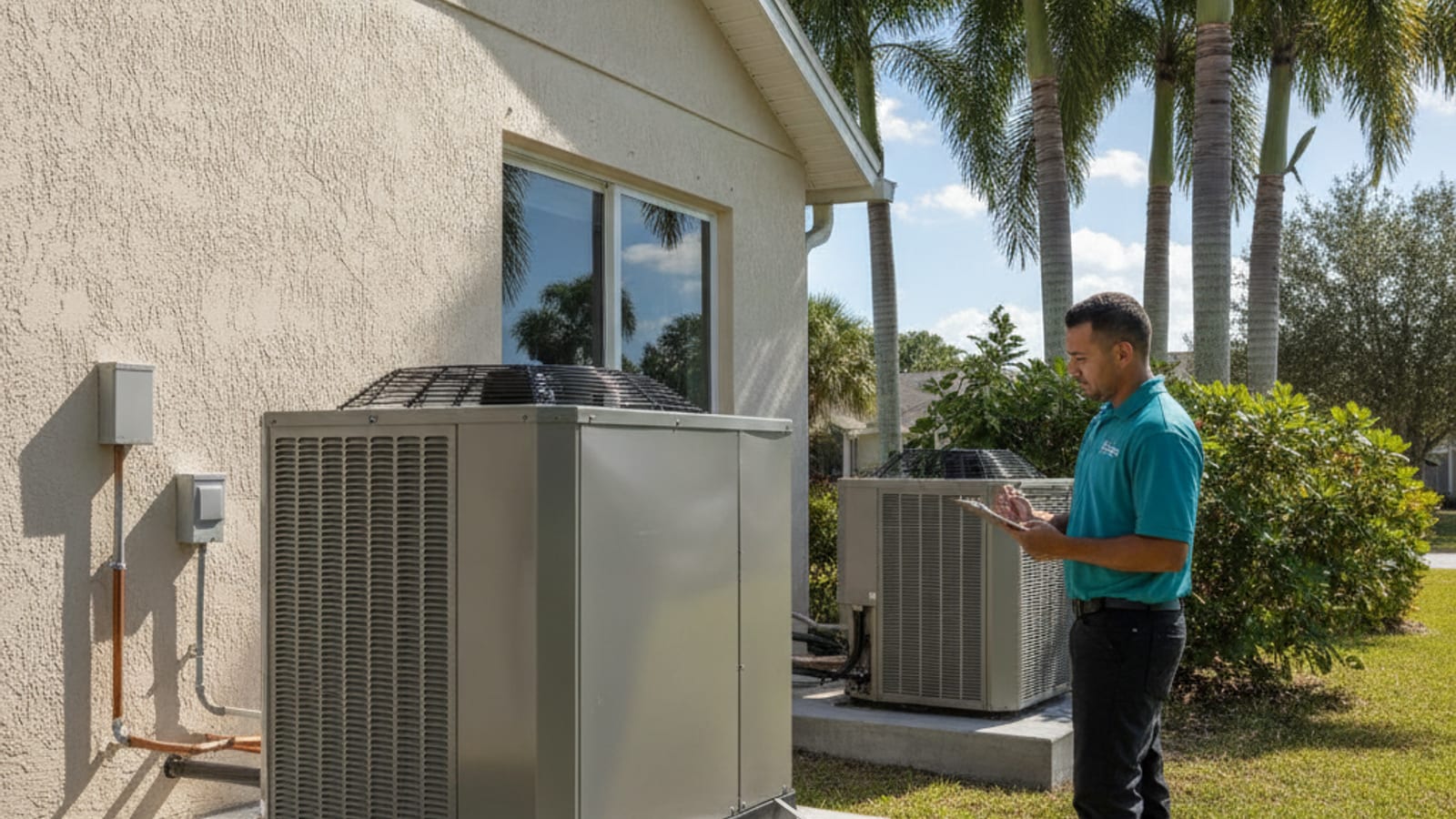
Ask a homeowner from the Northeast or Midwest what their new Englewood house’s HVAC system does, and a lot of them are surprised to learn there’s no furnace anywhere in the picture. In this market, the heat pump isn’t a green upgrade or a niche alternative to a standard AC system. It’s the standard system, full stop, and understanding why changes how you should think about replacing or buying one.
Why gas furnaces are rare on the Gulf coast
A gas furnace makes sense in a climate with sustained cold stretches, where a home needs real heating capacity for months at a time. Englewood’s winters don’t create that demand. Overnight lows dip into the 40s on the coldest nights of most years, and genuine freeze events are rare and short. Installing and maintaining a full gas furnace and the associated gas line infrastructure for that limited heating need doesn’t pencil out the way it does further north, which is why the vast majority of homes in this metro, new and old, simply don’t have one.
Instead, the same outdoor unit that cools the house all summer reverses its refrigerant cycle on the rare cold night and provides heat. One system, two functions, no separate furnace, no gas line, no second piece of major equipment to maintain.
How a heat pump actually works, briefly
A standard AC-only system moves heat from inside a home to outside, cooling the interior. A heat pump does the same thing in summer, then reverses that cycle in winter, pulling available heat from outdoor air and moving it inside. It sounds counterintuitive that there’s usable heat to extract from 50-degree outdoor air, but heat pump technology handles that efficiently down to a reasonable temperature range, which covers the vast majority of Englewood’s cold-weather nights without issue.
This is why heat pumps have become the default, not the exception, across nearly all new AC installation and replacement work in this metro. A homeowner replacing a straight AC-only system with a heat pump gets year-round comfort from one piece of equipment instead of needing a supplemental heat source for the handful of genuinely cold nights each winter.
Backup strip heat for the rare cold snap
Heat pump efficiency does decrease as outdoor temperatures drop, and on the occasional hard freeze night, a heat pump alone may struggle to keep up with heating demand. That’s what backup electric resistance heat, commonly called strip heat, is for. It’s a supplemental heating element built into the system that kicks in automatically during the coldest stretches to cover the gap.
Sizing that backup capacity correctly matters. Oversized strip heat sits unused almost the entire year and adds unnecessary equipment cost. Undersized strip heat means a home genuinely struggles to stay warm on the rare occasion it’s actually needed, usually a handful of nights each winter at most in this part of Florida. A properly sized system accounts for realistic worst-case winter temperatures for this specific metro, not a generic statewide assumption.
SEER2 standards for anyone replacing an old AC-only system
If you’re replacing an aging AC-only system that never had heating capability, this is the natural point to evaluate switching to a heat pump rather than installing another straight AC unit. The efficiency conversation has changed too. SEER2 is the current federal rating standard for cooling efficiency, replacing the older SEER metric, and it applies to heat pumps the same way it applies to standalone AC systems.
A higher SEER2 rating means lower FPL electricity costs for the same cooling output, which compounds meaningfully in a climate where the system runs close to year-round. When comparing a heat pump replacement quote against a straight AC replacement, factor in that a heat pump eliminates the need for any separate heating solution entirely, which is real cost avoidance beyond the cooling-efficiency comparison alone.
What this means if you’re buying or replacing a system
For most Englewood-area homeowners, the decision isn’t really heat pump versus AC anymore, since heat pumps have become the practical default for new installs across the metro. The real decisions are efficiency tier, matched to your budget and how long you plan to own the home, and correct strip-heat backup sizing for genuine winter performance. Ask any contractor quoting a replacement to walk through both explicitly rather than defaulting to whatever’s easiest to source.
This applies whether you’re in mainland Englewood itself or further inland in North Port, where winter lows can run marginally cooler than the immediate coastal strip. That small variation is still worth mentioning to your contractor when sizing backup heat capacity.
Maintenance is different for a system that never truly rests
A heat pump running in this climate operates closer to year-round than a straight AC-only system would in a market with a genuine off-season. Between near-constant summer cooling demand and periodic winter heating cycles, the equipment gets less downtime overall, which makes consistent maintenance more important, not less, compared to a system that gets a real seasonal break.
A tune-up scheduled specifically to check both cooling and heating function, rather than just confirming the AC side works, catches problems on the heating cycle that might otherwise go unnoticed until the one cold week a year when the home actually needs it. It’s a genuinely bad time to discover a heat pump’s reversing valve or defrost cycle isn’t working correctly, on the coldest night of the year with the system already under real demand. An annual check that specifically exercises the heating function ahead of winter avoids that scenario.
Why the reversing valve matters more than most homeowners realize
The component that lets a heat pump switch between cooling and heating modes, called the reversing valve, is the piece of equipment that doesn’t exist at all in a standard AC-only system. It’s mechanically simple but it’s also the part most likely to develop an issue specific to heat pump operation, since it cycles between two states rather than running in one fixed mode the way a standard AC compressor does.
A reversing valve that’s sticking or failing sometimes shows up as a system that cools fine all summer but won’t properly switch to heat mode when the first cold snap arrives. This is exactly the kind of issue a pre-winter tune-up is designed to catch, testing the heating cycle directly rather than assuming that because cooling has worked fine all year, the whole system is healthy.
When a straight AC-only replacement still makes sense
There are limited cases where sticking with AC-only equipment still makes sense, mainly budget-constrained replacements where the homeowner already has a separate, functioning heat source or genuinely doesn’t need heating capability at all. But for the vast majority of Englewood-area homes replacing aging equipment, a heat pump has become the standard recommendation rather than an upsell, simply because it’s the more practical system for this climate.
Do I need a heat pump if I already have a working AC system?
Not urgently, if your current AC-only system is functioning well and you have adequate heating for the rare cold night. But when it’s time to replace the system, a heat pump is worth strong consideration given how standard it’s become across this metro.
How cold does it get in Englewood, and can a heat pump handle it?
Overnight lows occasionally dip into the 40s during the coldest stretches of most winters, with rare, brief freeze events. A properly sized heat pump with correctly sized backup strip heat handles this range without issue.
What is strip heat and do I need much of it?
Strip heat is supplemental electric resistance heating built into a heat pump system that activates during the coldest nights when the heat pump alone can’t fully keep up. Given Englewood’s mild winters, most homes need only modest backup capacity, not a heavy-duty heating setup.
Is a heat pump more expensive to install than a standard AC system?
Heat pumps typically cost somewhat more upfront than a comparable AC-only system, but that difference usually offsets the cost of installing and maintaining a separate heating source, which most Englewood-area homes don’t need in the first place.
If you’re replacing an aging AC system or building new and want to understand your heat pump options, call (941) 292-6250 and we’ll connect you with a local HVAC pro who can size the right system and backup heat for your home.