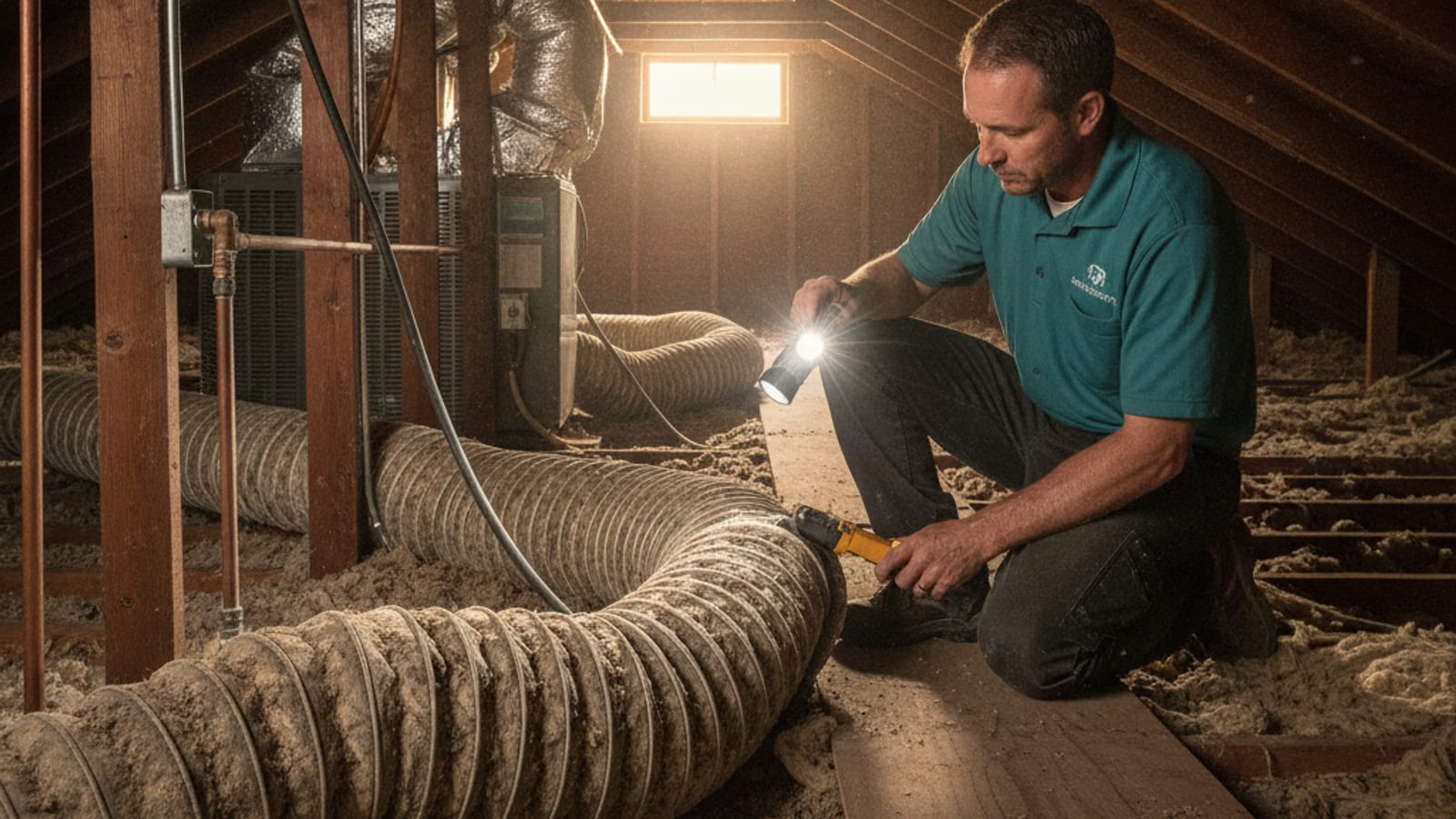
Port Charlotte’s original grid, platted decades ago by the General Development Corporation, is full of ranch homes now pushing fifty years old. A lot of them have never had their ductwork touched, and a duct system that old is doing far less than its owner probably assumes, even if the AC itself has been replaced once or twice along the way.
Why original 1970s ductwork fails on its own timeline
Ductwork doesn’t announce its failure the way a dead compressor does. It degrades gradually, through insulation breakdown, seam separation, and gradual duct-board or flex-duct deterioration, and a homeowner usually doesn’t notice until energy bills climb or specific rooms stop cooling well. In a fifty-year-old Port Charlotte ranch home, several failure modes tend to show up together rather than one at a time.
Duct board, common in this era’s original construction, loses structural integrity over decades of attic heat cycling, and the internal fiberglass insulation liner can degrade and shed fibers into the airflow. Metal ductwork from the same era develops seam separation at joints that were never fully sealed to begin with, since duct sealing standards from the 1970s were far looser than current code requires. Either way, air that’s supposed to reach a bedroom or back room is instead leaking into an unconditioned attic, and the AC system works harder to compensate without the homeowner necessarily realizing why.
Storm-driven versus age-driven duct failure since Hurricane Ian
Hurricane Ian added a second failure track on top of normal age-related wear. Wind-driven rain and roof damage during the 2022 storm let moisture into attics across this metro, and ductwork sitting in a wet attic space, even briefly, is prone to accelerated insulation breakdown and mold growth inside and around the duct system. A duct system that was marginal but functional before the storm can fail noticeably faster afterward if it took on any water exposure during roof repairs or the storm itself.
This creates a diagnostic challenge for homeowners trying to figure out why their ductwork suddenly seems worse than it used to. If your home had any roof damage or water intrusion during Hurricane Ian, even damage that seemed fully repaired, it’s worth having ductwork specifically inspected rather than assuming any current airflow or humidity issues are unrelated to the storm. Duct cleaning alone won’t fix physical duct damage or mold growth from water exposure, that requires a real inspection and likely partial or full replacement of affected sections.
What 50 years of wear actually looks like
A technician inspecting original 1970s ductwork in a Port Charlotte ranch home typically finds a combination of issues rather than one clean diagnosis. Insulation R-value has usually dropped well below what the duct board or wrap was rated for when new, since insulation degrades with heat cycling over decades. Seam and joint sealing has often failed at multiple connection points, sometimes visibly, sometimes only detectable with a pressure test. And in homes that have had any pest activity in the attic over the decades, physical duct damage from rodents chewing through flex duct or insulation is common enough that techs check for it as a matter of routine.
Add all of that up and a fifty-year-old duct system commonly loses 20 to 30 percent or more of conditioned air before it ever reaches a room’s supply vent. That’s air the AC system paid to cool that’s instead heating an attic, which shows up directly on FPL bills even when the AC unit itself is relatively new and running fine.
Charlotte County versus Sarasota County permit differences
Ductwork replacement or major repair work in this metro crosses two different county permitting jurisdictions depending on the property’s location. Charlotte County, which covers Port Charlotte and Punta Gorda, and Sarasota County, which covers Englewood’s northern reach into Venice, have their own permit processes and inspection requirements for major HVAC work. A contractor working across both counties regularly should be familiar with each jurisdiction’s specific requirements, but it’s reasonable to ask directly which county your project falls under and confirm the contractor has pulled permits there before.
This matters more for a full duct system replacement than a minor repair, since replacement work typically triggers a permit requirement that a small sealing job might not.
Repair versus full replacement
Not every aging duct system needs full replacement. Sealing failed joints, replacing isolated damaged sections, and adding insulation wrap to sections with degraded R-value can meaningfully improve performance on a system that’s otherwise structurally sound. A full ductwork replacement makes more sense when the majority of the system shows widespread insulation breakdown, extensive seam failure, or water and mold damage from storm exposure, since patching a system that far gone usually doesn’t hold up.
Get an actual inspection with photos or a pressure test showing where air is leaking before committing to either path. A reasonable contractor should be able to show you specifically what’s failing and why a repair or full replacement makes more sense for your system’s actual condition, not just quote a number based on the home’s age alone.
Why duct cleaning alone doesn’t fix a structural problem
Homeowners sometimes call for duct cleaning expecting it to resolve airflow or dust complaints, and while duct cleaning genuinely helps with air quality and can improve airflow in a system with buildup, it doesn’t address seam separation, insulation breakdown, or structural duct damage. Cleaning a fifty-year-old duct system that’s leaking at multiple joints removes accumulated dust and debris, which matters for indoor air quality, but the underlying leakage keeps costing money on every cooling cycle regardless of how clean the interior of the ducts gets.
It’s worth asking directly whether a scheduled cleaning includes any structural assessment of the ductwork itself, or whether it’s purely a cleaning service. The two are related but genuinely different scopes of work, and conflating them leads some homeowners to spend on cleaning while the actual air-leakage problem driving high bills goes unaddressed.
Attic insulation and Florida Building Code updates since the original construction
Florida’s building code around attic and duct insulation has tightened considerably since these ranch homes were originally built in the 1970s and 1980s. Current code requires meaningfully higher insulation R-values than what was standard when this housing stock went up, which means even ductwork that’s structurally intact by original standards often falls well short of what a modern install would specify.
When a full duct replacement does happen on one of these older homes, it’s a natural opportunity to bring the insulation up toward current code requirements rather than simply replicating the original 1970s specification. A contractor pulling permits for a full replacement in either Charlotte or Sarasota County should be building the new system to current code standards as a matter of course, but it’s reasonable to confirm that explicitly rather than assuming it.
What this means for homeowners in older Port Charlotte neighborhoods
If you own an original-construction ranch home anywhere in Port Charlotte’s older grid and you haven’t had ductwork specifically inspected, even if the AC unit itself was replaced within the last decade, it’s worth a dedicated duct evaluation. A newer, efficient AC system connected to a fifty-year-old leaking duct system is still losing a substantial share of its output before that cooled air ever reaches a room.
How do I know if my ductwork needs repair or just the AC unit is the problem?
A pressure test or a physical inspection with a duct camera can identify air leakage that a homeowner can’t diagnose just from uneven cooling or high bills. If a relatively new AC system still isn’t cooling evenly, ductwork is a common overlooked cause worth checking before assuming the equipment itself is at fault.
Can Hurricane Ian have damaged my ductwork even if my roof was fully repaired?
Yes. Brief water exposure during the storm or subsequent roof repairs can cause insulation breakdown and mold growth inside ductwork that isn’t visible without a direct inspection, even after the roof itself is fixed.
What percentage of cooled air is typically lost through old, leaky ductwork?
Twenty to thirty percent or more in a severely degraded system is common in ductwork this old, meaning a meaningful share of what the AC system cools never reaches the rooms it’s meant to condition.
Does duct replacement require a permit in Port Charlotte or Punta Gorda?
Major duct system replacement generally requires a permit through the applicable county, Charlotte or Sarasota depending on the property’s exact location, though requirements and thresholds vary. Confirm with your contractor which jurisdiction applies and that permits are being pulled for the scope of work.
If your Port Charlotte or Punta Gorda home has original ductwork that’s never been evaluated, call (941) 292-6250 and we’ll connect you with a local pro who can inspect it and tell you honestly whether repair or replacement makes sense.