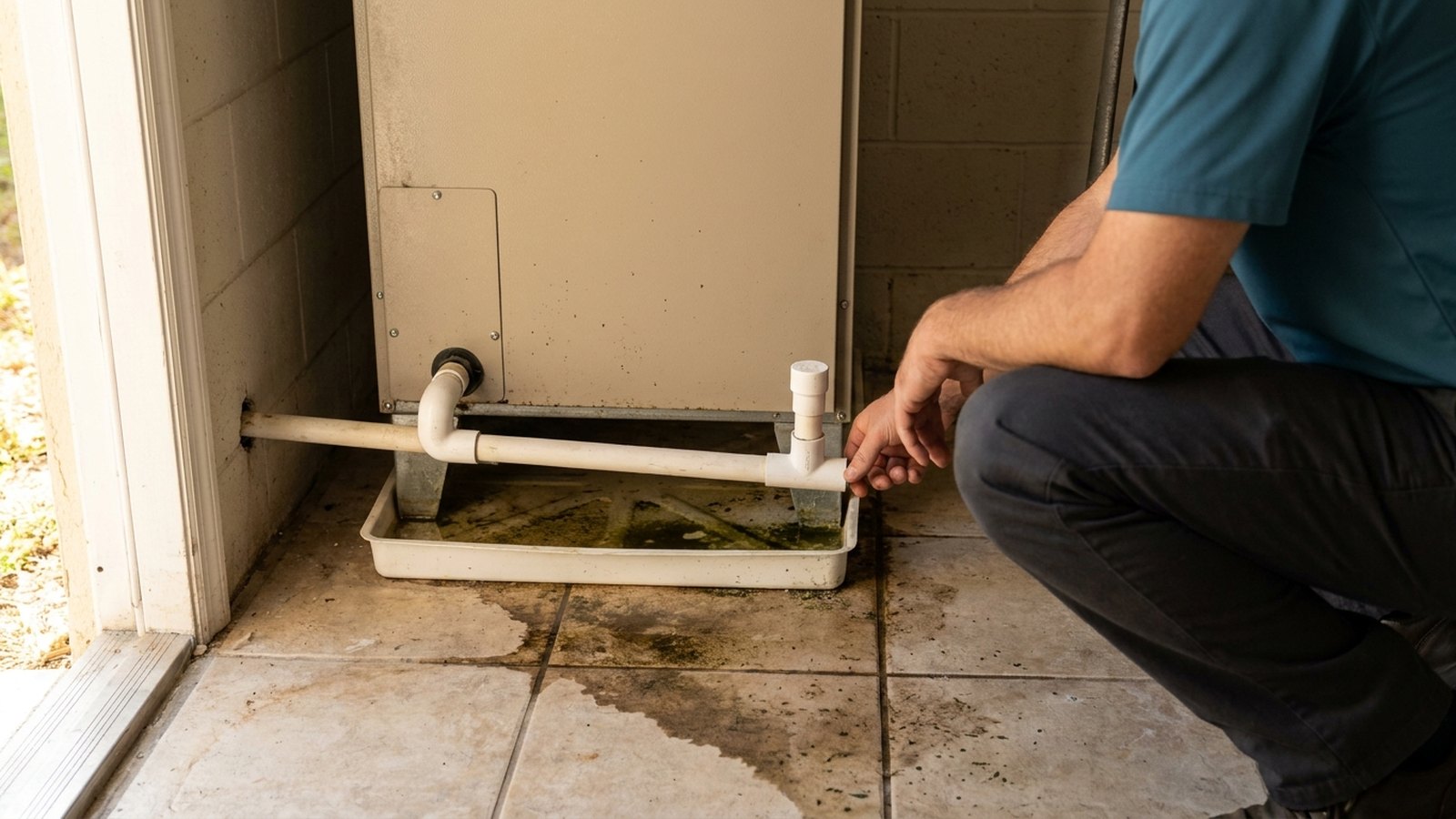
An AC drain line clogged with algae and dust stops condensation from leaving the air handler, so the water backs up instead. You’ll see it pool near the unit, drip somewhere obvious outside, or you’ll find the system shut off on its own. Florida’s residential code expects that blockage and requires the drain to be built so a technician can clear it without cutting the pipe. Getting it cleared early is the difference between a service call and a ceiling repair.
AC drain line clogged: what does it mean?
Your AC pulls humidity out of the air all day, and that water has to go somewhere. It leaves through a pipe connected to the equipment’s drain pan. When that pipe restricts, the water has nowhere to go but backward.
Water pooling around an Englewood air handler usually means the condensate line is clogged. Algae and dust build up fast inside a line that runs nearly year-round. Florida humidity keeps these drains working far harder than they’d work in a cooler climate.
A shutdown doesn’t mean the AC itself failed. Often a water-level device stopped the equipment on purpose, before the pan could overflow.
That’s easy to mistake for several other problems. The thermostat still has power while the cooling equipment sits silent. Our AC not turning on guide walks the broader starting checklist, since not every dead system is a drain problem.
These signs support a clogged-line diagnosis:
| What you notice | What it may indicate |
|---|---|
| Water pooling near the air handler | Condensate isn’t leaving through the primary drain |
| Cooling stops without a breaker trip | A water-level device may have shut off the equipment |
| Water drips over a window or soffit | A conspicuous auxiliary outlet may be signaling a blockage |
| The drain pan contains standing water | The primary drain may be restricted |
| Water reaches a closet or ceiling | The blockage needs prompt professional attention |
These clues point the same direction, but they aren’t interchangeable. Have a licensed HVAC contractor look at the whole drainage path before anyone restarts the system.
Why does an AC drain line clog in Englewood?
Englewood’s cooling season runs about nine months, so the condensate line almost never gets a dry spell. Algae and dust get nine months a year to collect inside the pipe. That’s why a clogged drain here is a seasonal certainty rather than bad luck.
A clean filter won’t clear a blockage that’s already there. It does cut down the dust heading toward the coil in the first place. Most Englewood homes need a filter change every 30 to 60 days, and homes with pets or a system that runs flat out all summer need it more often.
Long attic runs are where this shows up first. Plenty of local housing dates to the late 1970s through early 1990s building boom, and those systems often drain through a long, shallow run above the ceiling. The flatter the run, the harder the water has to work to reach the outlet.
The same Gulf-coast conditions hit homes in Rotonda West, South Venice, Port Charlotte, Placida, and Cape Haze. Layouts differ, but every condensate line needs a clear route to its disposal point.
Two tune-ups a year is the cadence that catches this, one before peak summer and one in fall. A technician checking the drain in April is a lot cheaper than one chasing water in July.
Our HVAC maintenance service covers that scheduled care for local homes. The Englewood AC maintenance guide has the wider plan if you’re building one.
Why did the AC shut itself off instead of flooding?
A water-level device stops the system when condensate can’t drain. That shutdown is what keeps an overflowing pan away from your drywall and your ceiling.
It isn’t required on every system, though, and that surprises people. Florida code makes the protection conditional, tied to whether overflow would damage building components, and it permits four different methods.
Method 4 under Section M1411.3.1 states: “A water level detection device conforming to UL 508 shall be installed that will shut off the equipment served in the event that the primary drain is blocked.”
So a float switch is one permitted option, not a universal mandate. The code doesn’t demand the same device on every installation.
Some systems use an auxiliary pan and a visible drain outlet instead. That drip you keep noticing isn’t random when this method is installed. It’s the alarm.
The same section says: “The auxiliary pan drain shall discharge to a conspicuous point of disposal to alert occupants in the event of a stoppage of the primary drain.”
That’s why water shows up over a window or under a soffit. The outlet is deliberately put where somebody will see it.
Down-flow systems get separate treatment under Section M1411.3.1.1, which covers down-flow units and coils with no secondary drain or provision for an auxiliary pan. On those, a monitoring device belongs inside the primary drain pan, and it has to shut off the equipment when the primary drain becomes restricted. The code is specific about placement too: “Devices shall not be installed in the drain line.”
Don’t bypass or reset one of these devices to get cooling back. That shutdown may be the only thing standing between you and an overflow.
A tech dispatched through our Englewood AC repair service can check the pan, the drain path, and the protective device together. Englewood Air Pro connects homeowners with licensed and insured local HVAC contractors.
What does Florida code require for a condensate drain?
Quite a lot, and almost nobody writing about clogged drains mentions it. The governing document is the Florida Building Code, Residential, 8th Edition (2023), effective December 31, 2023. Section M1411.3 covers condensate disposal from cooling coils and evaporators.
Its basic requirement is direct: “Condensate from cooling coils and evaporators shall be conveyed from the drain pan outlet to an approved place of disposal.”
Several details explain how that drainage path should function:
| Code provision | What it requires |
|---|---|
| M1411.3 | The pipe needs at least 1/8 unit of vertical fall per 12 horizontal units |
| M1411.3 | That minimum equals a 1-percent slope toward discharge |
| M1411.3.2 | Drain piping must be at least 3/4-inch nominal diameter |
| M1411.3.3 | Blockages must be clearable without cutting the drain line |
| M1411.3 | Discharge can’t enter a street, alley, or nuisance area |
| M1411.3.1 | Overflow protection applies where building components could be damaged |
Section M1411.3.3 contains the most useful requirement for a clogged line. It says, “Condensate drain lines shall be configured to permit the clearing of blockages and performance of maintenance without requiring the drain line to be cut.”
Read that again, because it’s the part worth knowing. The code assumes the line will block up someday and requires it to be built so a technician can clear it without cutting the pipe. A clogged drain doesn’t mean your installation is defective. It means the maintenance access the code called for is now the thing that matters.
Slope and pipe size matter for the same reason. The line needs enough fall to move condensate toward the outlet, and it needs the required diameter the whole way there. A technician can tell you whether the existing route actually supports that, which is worth asking when a long attic run keeps backing up.
These are statewide residential provisions. Confirm the exact scope of any job with the contractor doing the work.
How can you tell a clogged drain from another AC problem?
Water near the air handler is the strongest clue you’ve got. A shutdown with standing water in the pan makes it stronger.
Other faults look different. A breaker that trips over and over points at an electrical or equipment problem, not drainage, and you shouldn’t keep resetting it after the first trip. An AC that runs but won’t cool usually has a refrigerant or airflow issue instead. Our AC repair cost guide covers the wider repair range and the common service categories.
A drip outside deserves attention even when the house is still cooling. It can be the auxiliary drain telling you the primary line has stopped flowing.
Don’t ignore water pooling at the air handler either. It reaches a closet or a ceiling fast when the protective method doesn’t catch the overflow.
None of this is a reason to open the air handler yourself. Don’t bypass a float switch and don’t force the system back on. A professional inspection keeps the warning system intact while the actual blockage gets dealt with.
What does clearing a clogged AC drain line cost in Englewood?
A drain blockage caught early sits near the bottom of the repair range. With no other damage, it often lands close to the diagnostic itself.
The published diagnostic range is $89 to $150.
Most AC repairs cost $150 to $650 after the diagnostic.
A maintenance or tune-up visit costs $89 to $150.
Emergency dispatch and diagnostic service costs $200 to $450.
There’s no separate fixed price for drain clearing inside those bands. The HVAC provider sets the final number after seeing the system.
Access, where the blockage sits, and any related equipment trouble all change the work. A simple restriction is a different job from water that’s already found a ceiling.
Once water damages the building, that’s a separate bill. It isn’t part of the HVAC drain-clearing price and it isn’t quoted by the HVAC contractor.
Book the AC tune-up service if the system still runs and you want the drain checked on schedule. Standing water or a shutdown belongs with AC repair instead.
Standard hours here are Monday through Saturday, 7 a.m. to 7 p.m. Anything urgent outside that window goes to emergency HVAC service.
When does a clogged drain line become an emergency?
It’s urgent the moment water reaches building materials. It’s also urgent when a protective device has already shut cooling down, because that’s the system telling you it can’t drain.
Water spreading through an air-handler closet takes finishes with it. An attic or ceiling-mounted unit puts the rooms underneath at risk too.
A visible drip from an auxiliary outlet is the cheap version of this problem. Calling then, before the primary pan overflows, is what keeps the work near the low end of the repair band.
Don’t keep restarting equipment that a water-level device stopped. The drainage path needs checking before the system runs normally again.
Englewood Air Pro offers 24/7 emergency referral service across Sarasota and Charlotte counties. The pros we dispatch carry their own licenses and insurance.
Homeowners in Rotonda West can request local help through the Rotonda West HVAC service page. The broader Englewood HVAC service hub covers additional nearby communities.
Call (941) 292-6250 when water is spreading or cooling won’t restart. We’ll connect the request with a licensed local HVAC provider.
Frequently asked questions
Can a clogged AC drain line shut off the whole system?
Yes. A water-level device shuts the equipment off when drainage gets restricted, which protects the ceiling below. Not every installation uses the same protection method, so check yours.
Why is water dripping above my window or from a soffit?
That’s often the auxiliary drain doing its job. Florida code lets that outlet discharge somewhere conspicuous specifically to alert occupants when the primary condensate drain stops flowing.
Does Florida code require a float switch on every AC system?
No. Overflow protection is conditional, required where building components could be damaged, and a water-level shutoff is only one of the four methods the code permits.
How much does clogged AC drain line service cost?
Diagnostics run $89 to $150 and most repairs run $150 to $650. A drain caught early usually sits near the bottom of that repair range, close to the diagnostic itself.
Should I reset the float switch when my AC stops?
No. Don’t bypass or reset the protective device to get cooling back. Have a licensed HVAC contractor inspect the pan and the drainage path before the system restarts.
How often should an Englewood AC receive maintenance?
Twice a year is the cadence that works here, once before peak summer and once in fall. Most Englewood homes also need a filter change every 30 to 60 days.