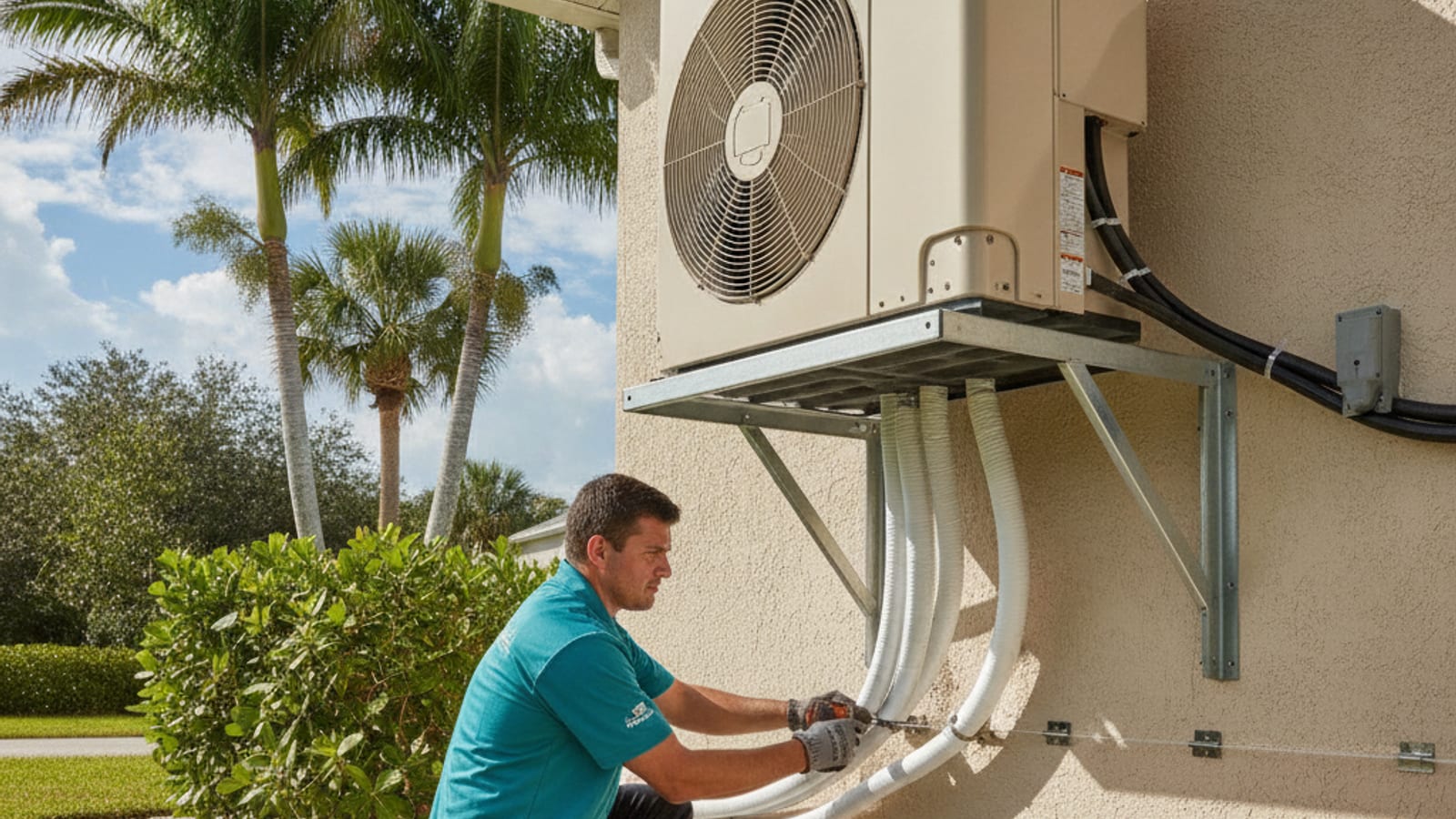
A ductless air conditioner sits somewhere between a window unit and a full central system. There’s a compressor outside, quiet indoor wall units in the rooms you want to cool, and refrigerant lines connecting them through small wall penetrations. No ductwork, no attic crawling, no long supply runs. It sounds simple because it is, and that simplicity solves real problems for a lot of Englewood homes.
How ductless air conditioning actually works
The outdoor compressor is the same core equipment you’d find in any AC system. It pressurizes refrigerant and sends it out to the indoor units. Each indoor unit has an evaporator coil that cools and dehumidifies the air in that specific room or zone. A small line set, typically no bigger than your thumb, carries refrigerant and condensate to and from the house through a modest hole you drill through the wall.
The control comes from your thermostat or a remote, and each zone operates independently. Your bedroom can stay at 72 degrees while the living room runs at 76. That’s genuinely different from central air, where one thermostat controls the whole house regardless of how much sun hits different rooms.
Why ductless systems matter in Gulf-coast Florida
Englewood’s hot, humid climate is exactly where a ductless system’s strengths show up. These systems run their compressor and fans in proportion to actual zone demand rather than trying to satisfy an entire house through a single network of ducts. That means shorter run cycles and better dehumidification, which matters more here than anywhere else.
A traditional central system that’s oversized relative to the space it’s cooling will cycle on and off quickly, leaving the air cool but not properly dry. A ductless system that’s sized right per zone tends to avoid that problem, so the house feels less clammy on those high-humidity July afternoons when the outdoor air is basically soup.
Central AC versus ductless: the real tradeoffs
A full central system with proper ductwork, installed during new construction or a complete renovation, is still the most efficient way to cool a big house, and it’s often quieter than ductless because the compressor sits outside and the distribution happens through the ducts rather than through wall-mounted units. It also looks cleaner inside, with nothing but registers and thermostats visible.
Ductless loses that invisible beauty. You’re looking at indoor units on walls or ceilings, which some people like and some people don’t. They do make a little more noise than the indoor air handler in a central system, though modern units are pretty quiet. They also cost a bit more per ton of cooling capacity upfront than central air, though they can be cheaper to install if ductwork is impractical or you’re only cooling specific zones.
Central air needs ducts, though. If your Englewood home was never built for them, adding them after the fact is invasive work, and if adding a zone to an existing central system means extending ductwork through a long attic run or through walls, the installation gets expensive and disruptive fast. A ductless zone sidesteps all of that.
When ductless cooling wins in Englewood specifically
Additions and renovations. Lots of Englewood homes have lanais, Florida room conversions, or garage-to-bedroom changes that were never wired into the original central system. Running new ductwork to those spaces often means tearing into walls or ceilings or trying to squeeze flex duct through an already crowded attic. A ductless zone to that addition is often installed in a day without major disruption.
Older homes without existing ducts. Pre-1960s cottages in Englewood Core or Placida were designed around window units, not central air. If you’re upgrading from window units to real central-air comfort without rebuilding the whole interior of the house, ductless AC is a practical answer.
Zoning problems in existing central systems. If you’ve got a central system but one room is perpetually hot while another is cold, or if you have a spare bedroom you only want to cool occasionally, a ductless zone in that trouble area can be cheaper than redesigning ductwork or running a whole second AC system. Our guide to HVAC zoning in Englewood compares that choice against zoning the central system you already have.
New construction with zone preferences. Some new-build homes in Wellen Park and North Port are sized for a single central system, but a homeowner might want independent control over a master bedroom suite or a home office. A ductless zone gives that without redesigning the whole system.
Humidity control is the hidden advantage
This matters more than most people think. In Englewood, a humid coastal environment, keeping indoor humidity in the safe range (30 to 50 percent) is a health and mold-prevention issue, not just comfort. Ductless systems handle this well because each zone runs in proportion to its actual load rather than overshooting and cooling too fast.
A central system that’s oversized or improperly ducted can actually make humidity worse, because it cools the air without giving the evaporator coil enough dwell time to wring out moisture. Ductless zones avoid that problem structurally.
Multi-zone versus single-zone ductless systems
A single-zone ductless system has one indoor unit connected to one outdoor compressor. This works for one room, a small addition, or a standalone renovation project. One outdoor unit, one power line to run, simple installation.
A multi-zone system connects multiple indoor units (usually two to five) to a single larger outdoor compressor. This makes more sense when you’re cooling several rooms or an entire smaller home, because you get better efficiency from one larger compressor than several smaller ones scattered around your property, and you don’t end up with three or four outdoor units taking up your whole backyard.
The tradeoff is flexibility. In a multi-zone system, if one zone (say a sun-drenched west-facing room) needs to run harder than the others, the compressor has to step up for the whole system rather than just that one outdoor unit. For most Englewood homes, that tradeoff is worth it. But if you’ve got zones with very different cooling needs at different times, single-zone units give you more independent control.
What installation looks like
A ductless installation is faster and quieter than central ductwork or a major central system upgrade. The outdoor unit gets bolted to a pad or bracket on the side of the house. Wall-mounted indoor units go on the wall or ceiling where you want cooling. A technician drills a small hole for the refrigerant lines and condensate drain, threads them through, seals the penetration, and connects the refrigerant charge at both ends.
Most ductless zones install in a single day or two, which means you’re not living in a construction zone for weeks. There’s no noise from air compressors and no dust inside from opening walls or ceilings.
Maintenance is simpler than you might think
Each ductless indoor unit has a washable filter that sits behind the front panel. Most manufacturers recommend checking and cleaning it every two to four weeks during cooling season if you’re running the system a lot. It’s easier maintenance than accessing a central system’s return-air filter, which sometimes ends up in an attic or a mechanical closet that’s a crawl to reach.
The downside is that maintenance only helps if you actually do it. A neglected ductless filter loses efficiency the same way a neglected central filter does, so building it into a regular household routine matters.
Cost reality in Englewood
A ductless system costs more per ton of cooling than a central system upfront, but if you’re not cooling an entire large home and you’re comparing it to extending existing ductwork or installing a brand-new central system from scratch in a home without ducts, the total cost picture often favors ductless.
Single-zone systems start around $3,000 to $5,000 installed. Multi-zone systems for a few rooms or a small home run closer to $8,000 to $12,000 depending on the number of zones and the quality of the equipment. Central system costs vary wildly based on whether ducts already exist, but if you’re adding new ductwork from the ground up to a home without it, you’re often in that same ballpark or higher.
Is ductless right for your Englewood home?
Ductless cooling makes sense if:
- You’re cooling an addition or a room that’s disconnected from your central system
- You have an older home without existing ductwork
- You want zone-by-zone control to balance comfort and efficiency
- You value quiet operation and simple installation
- You don’t mind indoor wall units as part of your home’s interior
It might not be your best choice if:
- You’re cooling a large, whole-house footprint where central AC with proper ductwork is more efficient
- You prefer completely invisible cooling equipment
- You have a very tight interior design where wall units don’t fit
The bottom line: ductless air conditioning is a genuinely practical solution for Englewood homes with specific cooling needs or existing constraints. It’s not the default choice for every situation, but when it fits, it solves real problems that other systems can’t.
What exactly is a ductless air conditioner?
A ductless system is an AC unit without ducts. An outdoor compressor connects to indoor wall or ceiling-mounted units through small refrigerant lines that run through a modest wall penetration. Each zone operates independently.
Are ductless AC units quiet?
Modern ductless systems are pretty quiet, though you’ll hear a bit of noise from the indoor units during operation. They’re generally quieter than older window units and comparable to central air handlers.
How long does ductless AC installation take compared to adding central air with ducts?
Most ductless zones install in a day or two. Adding ductwork to an existing home typically takes much longer and involves more disruption to walls and attics.
Do ductless systems need more maintenance than central AC?
Maintenance is actually simpler: each unit has an accessible washable filter. But you have to actually do it every two to four weeks during the cooling season. Central systems require less frequent filter changes but the filter is sometimes harder to reach.
Can ductless AC replace central air if I hate my current system?
Often yes, especially if your existing ductwork is aging poorly or undersized. Ductless zones can take over cooling from underperforming central ducts while you decide whether to retrofit the whole system.
If you’re thinking through cooling options for your Englewood home, call (941) 292-6250. We can walk through whether ductless AC makes sense for your layout and budget.