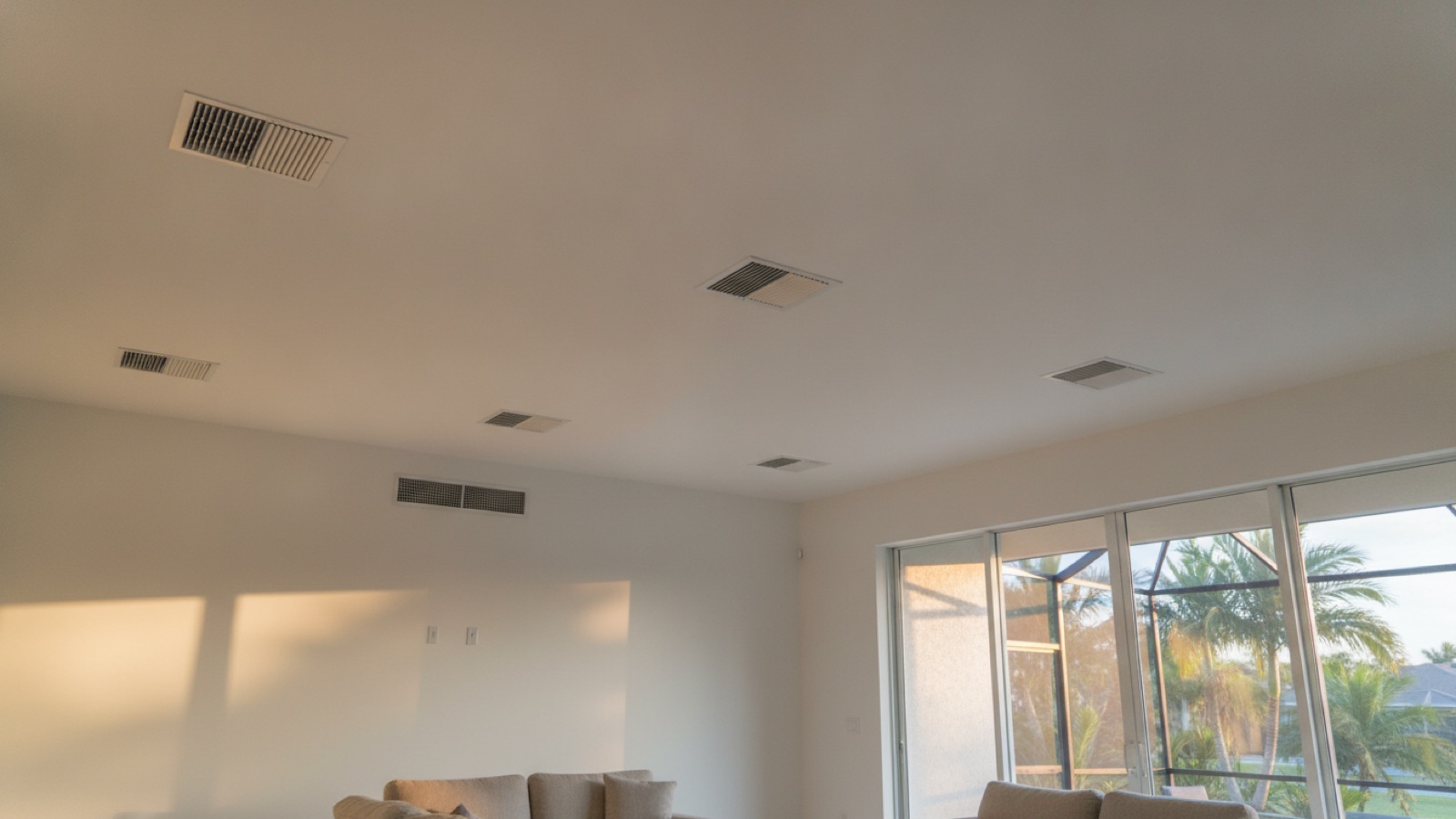
HVAC zoning splits one central ducted system into several thermostat-controlled areas. It doesn’t give you two AC systems, and that difference decides most of what follows. For an Englewood house, the real question is whether your equipment and ducts can serve smaller areas without losing the airflow that pulls humidity out.
What is HVAC zoning?
Zoning lets different parts of the house call for cool air on their own schedule. Each zone gets its own thermostat, but every zone shares one heating and cooling system.
That’s the distinction to hold onto when you’re weighing zoning against a second system. Florida’s energy code counts systems, not zones.
Section R403.1.1 of the Florida Building Code, Energy Conservation, says: “At least one thermostat shall be provided for each separate heating and cooling system.”
A zoned central system still has one source of cooling. The controls just change where that air goes. A second system adds a separate source with its own thermostat and its own equipment outside.
Zoning is worth a look when several rooms already share usable ductwork. The catch is what the equipment does when only one zone calls for air.
A single-stage system has exactly one output. Closing off dampers doesn’t make it a smaller system. It pushes the same output through fewer openings.
So the equipment, the controls, and the duct design are one decision, not three. Swapping in a new thermostat doesn’t get you a zoned house.
Should you choose zoning, a second system, or ductless air?
Start with the ducts you already have and the rooms giving you trouble. The right answer comes down to whether those rooms can share the central equipment without starving it.
| Option | When it’s worth a look | What to check first |
|---|---|---|
| Ducted HVAC zoning | Several rooms already share usable central ductwork | Equipment output, zone controls, airflow, duct condition |
| A second system | One part of the house needs its own equipment | Where the equipment goes, install scope, separate controls |
| A ductless zone | Reaching the room through ducts would tear up the house | Head placement, zone count, what the room actually needs |
The cheapest time to zone is during an AC installation or replacement, because the equipment, controls, and ducts all get specified at once.
A second system is the bigger swing, since it adds its own equipment. AC installation runs $5,500-$12,000 installed for most single-family homes. Heat pump installation runs $6,000-$14,000 installed.
A ductless zone skips the long attic run or the opened wall entirely. Mini split installation runs $3,500-$8,000 depending on zone count, and the ductless air conditioner guide for Englewood walks through when that’s the better fit.
Duct condition often settles the argument on its own. Crushed or badly routed runs need attention before zoning them makes any sense. Ductwork repair costs in Englewood run $1,500-$6,000 depending on scope.
How does Florida’s energy code treat HVAC zoning?
Here’s the part almost nobody writing about zoning mentions. The energy code mostly leaves existing houses alone. Section R101.4.2 says:
“Buildings exempt from the provisions of the Florida Building Code, Energy Conservation, include existing buildings except those considered renovated buildings, changes of occupancy type or previously unconditioned buildings to which comfort conditioning is added.”
Section 553.902(6), Florida Statutes, sets the first of those three. A renovated building is one undergoing alteration to insulation, HVAC systems, water heating systems, or exterior envelope conditions, where the estimated cost of renovation exceeds 30 percent of the assessed value of the structure.
A code official applies that test to your project, not to zoning in general. So the practical answer for most existing Englewood homes is that a zoning job doesn’t drag the whole house into the energy code.
The disaster threshold works differently, and that matters here. The same statute continues:
“However, if the alteration is a result of a natural disaster that is the subject of a declaration of a state of emergency by the Governor, the estimated cost of renovation must exceed 75 percent of the fair market value of the building before the natural disaster.”
Read that carefully: the alteration itself has to be a result of the declared disaster. Hurricane Ian doesn’t make every project in Englewood since 2022 qualify, and the code official decides whether the provision applies at all.
When the energy code does reach an alteration, Section R503.1.2 is the section that matters:
“New heating, cooling and duct systems that are part of the alteration shall comply with Sections R403.1, R403.2, R403.3 and R403.6.”
Its exception covers shorter duct extensions in unconditioned space, which in Englewood means the attic:
“Where ducts from an existing heating and cooling system are extended, duct systems with less than 40 linear feet (12.19 m) in unconditioned spaces shall not be required to be tested in accordance with Section R403.3.3.”
The printed text doesn’t say whether those 40 feet are the new extension or the whole duct system. That measurement is the code official’s call, so ask before anyone quotes the job on an assumption.
Section R403.3.1 adds a prescriptive attic-duct requirement:
“Supply and return ducts in attics shall be insulated to a minimum of R-8 where 3 inches (76 mm) in diameter and greater and R-6 where less than 3 inches (76 mm) in diameter.”
That one is prescriptive rather than mandatory, and it only reaches a zoning job through Section R503.1.2. Any new branch runs in the attic are where it shows up.
Permitting is its own question, and Englewood makes it messier than most towns. ZIP 34223 sits in Sarasota County and ZIP 34224 sits in Charlotte County. The Englewood AC permit guide covers the process, and the contractor assigned to your job should confirm which side of the line your address is on.
Why do equipment sizing and humidity matter?
The energy code may step aside, but the residential code doesn’t. Section M1401.3 requires approved sizing methods based on calculated building loads, whatever the controls do.
That section carries an exception, and it’s the most useful line in this whole conversation. It lifts the capacity limit for equipment using multistage technology or variable refrigerant flow, where the calculated loads sit within the manufacturer’s published capacities.
Look at what the code singles out. Multistage and variable-flow equipment can actually run at different outputs, which is exactly what zoning needs. A single-stage unit can’t, so zoning it means throttling airflow instead of matching capacity.
That’s why a contractor has to check airflow across the coil when only one zone calls. Zone controls can’t fix equipment that was never matched to the house.
In Englewood, humidity raises the stakes. A system that cools fast and shuts off leaves rooms cold and sticky, because the house hits temperature before the coil has run long enough to pull real moisture out.
Our guide to an oversized AC unit in Englewood covers the sizing calculation and Section M1401.3 in full. Do that work before anyone picks out zone controls.
A whole-home dehumidifier handles moisture separately from temperature, and installation runs $1,800-$3,500. It’s a reasonable companion to zoning. It isn’t a substitute for equipment and ducts that fit the house.
What price context helps compare the options?
A ducted zoning retrofit needs a quote on your house. The scope swings from thermostats and controls all the way to duct changes or new equipment, so there’s no honest single number for it.
Thermostat installation runs $250-$500 including install. That’s the controls, not a zoning retrofit.
The packages we do publish give you useful anchors:
- A zoned system, whole-home dehumidifier, and smart controls in Nokomis runs $8,500-$16,000 depending on home size and system complexity.
- A high-end Cape Haze installation with zoning and smart controls runs $9,000-$16,000 depending on square footage and zone count.
- New-construction installations in Wellen Park run $6,000-$11,000 depending on tonnage and zoning.
Those are coordinated packages, not zoning by itself, and the homes behind them aren’t alike. Read them as range-finders.
An HVAC contractor serving Englewood can price the real options after looking at your ducts. Ask for a quote that separates controls, ductwork, equipment, and humidity work, so you can see what you’re actually buying.
Where does zoning fit around Englewood?
New construction around Wellen Park and North Port is where zoning usually gets designed in from the start, before anyone has to retrofit anything.
Casey Key, Cape Haze, and Boca Grande are where zoned packages actually get quoted. Those jobs often bundle a dehumidifier in while a crew is already on site.
Englewood’s older cottages are a different decision entirely. The Dearborn Street cottages in Englewood Core and older Grove City homes were built before central ducted AC was standard, so there’s often nothing good to zone.
Running new ducts through those houses gets invasive fast. A ductless zone usually beats rebuilding the place around new branch runs.
If you do have a central system with usable ducts, start with a ductwork assessment, then compare what the equipment can put out against the areas each zone would serve.
The control plan comes last, and it may need multi-zone thermostat configuration. Controls follow the mechanical design. They don’t replace it.
Frequently asked questions
Is HVAC zoning the same as having two AC systems?
No. Zoning puts several thermostat-controlled areas on one system. Two AC systems are two separate heating and cooling systems, each with its own equipment and its own thermostat.
Can HVAC zoning fix one hot room?
Sometimes. The contractor has to confirm the central ducts and equipment can actually serve that room first. When reaching it means a long new duct run, a ductless zone is usually the more practical fix.
Does a zoning retrofit trigger Florida’s energy code?
Not automatically. Existing buildings are largely exempt unless one of the code’s three listed conditions applies. A code official decides whether your project’s scope and value meet the statutory renovation test.
Does HVAC zoning require new ductwork?
It depends on the existing layout and the zones you want. If new ducts end up part of an alteration the energy code covers, Section R503.1.2 pulls additional sections into the review.
How much does HVAC zoning cost in Englewood?
A ducted zoning retrofit needs a quote on your house. The related work runs from $250-$500 for thermostat installation to $1,500-$6,000 for ductwork, depending on scope. Neither figure is a zoning total.
Which county reviews an Englewood HVAC project?
Your address decides it. ZIP 34223 is on the Sarasota County side and ZIP 34224 is in Charlotte County. The contractor assigned to your job should confirm the process before work starts.
Compare your home’s zoning options
Englewood Air Pro connects homeowners with local, licensed HVAC providers. The provider we route you to can look at the equipment, the ducts, the controls, and the rooms that never feel right.
Call (941) 292-6250 to ask for a zoning assessment. We’ll send it to a provider covering your part of Englewood, on either side of the county line.