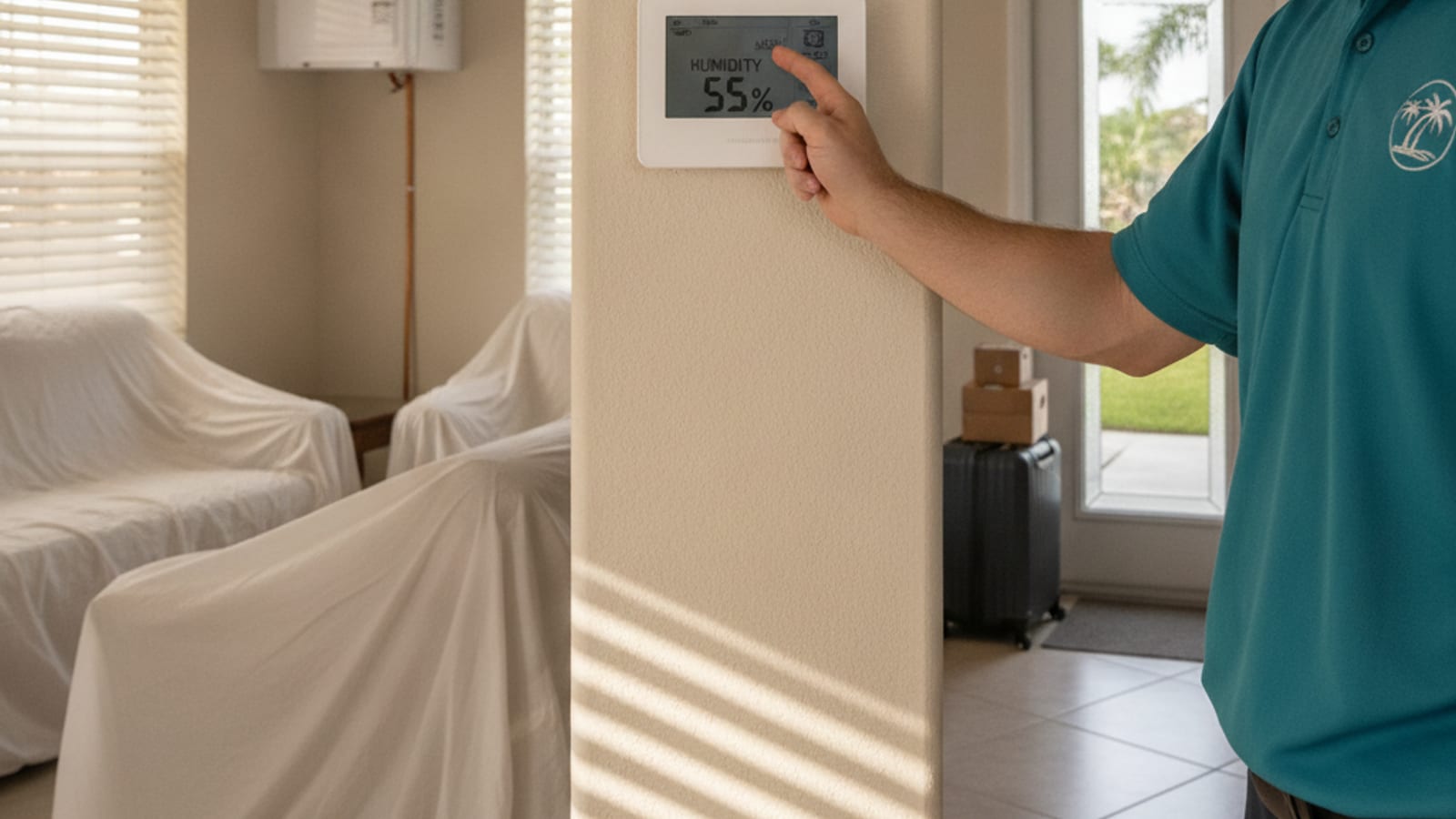
A whole-home dehumidifier in Englewood runs $1,800 to $3,500 installed. Before spending that, ask a different question first. Is the house actually missing a dehumidifier, or is an oversized AC system that short-cycles the real problem? Cooling and dehumidifying are two separate jobs. A system built to drop the temperature fast doesn’t automatically do the second one well.
Englewood Air Pro connects Sarasota and Charlotte county homeowners with local HVAC pros for indoor air quality work, including whole-home dehumidifiers sized to the actual house rather than guessed at. Here’s how to tell which problem is actually sitting in your living room.
Why humidity control is a different job than cooling
An AC system does two things at once. It cools the air. It also pulls moisture out of that air as the humid air passes across a cold coil. The cooling part happens fast. The moisture removal part takes time. Water has to condense on the coil and drain away before it counts as humidity actually leaving the house. A system sized purely to satisfy the thermostat can cool a room to setpoint and shut off early. It shuts off before it’s run long enough to pull much moisture out at all. That’s short-cycling. In a climate this humid, it’s the single most common reason a house can hit its target temperature and still feel damp against your skin.
An oversized AC unit makes this worse, not better. Bigger capacity means the temperature drops even faster. Faster drops mean less runtime per cycle, and less runtime means less dehumidification. Correctly sizing the AC fixes part of the problem. It doesn’t always fix all of it. That’s where a dedicated dehumidifier comes in.
What a whole-home dehumidifier does that the AC doesn’t
A whole-home unit ties into the existing ductwork and runs on its own schedule. It targets a humidity number directly, instead of waiting on a temperature-driven cooling cycle to handle moisture as a side effect. That matters most on a mild, humid day when the AC barely runs at all. A house can sit at a comfortable temperature and a miserable humidity level at the same time. Installation typically runs 2 to 4 hours per component. The unit gets sized to the home’s actual square footage, not a generic default pulled off a spec sheet.
What moves the price within that $1,800 to $3,500 range?
Two things, mostly. Unit size is the first, since a dehumidifier gets matched to the square footage it has to keep dry rather than to a default off a spec sheet. The second is how accessible your ductwork is, because the unit has to tie into it. An easy tie-in is quick labor. A hard one costs more for the same equipment. Getting the sizing right matters more than shaving the install cost, since an undersized unit runs constantly and still loses ground.
What humidity level should an Englewood home actually target?
The target depends on whether anyone’s living in the house day to day. A cheap hygrometer from a hardware store is enough to check your own numbers room by room before you price anything.
- An occupied, daily-lived-in home should hold 40 to 50 percent relative humidity, with real mold and dust-mite risk starting past 60 percent.
- A closed-up seasonal home should hold a slightly higher 55 to 60 percent, since the goal there is keeping mold out of an empty house, not daily comfort.
We cover that second scenario in more depth in our snowbird AC shutdown checklist, including how a remote-monitoring thermostat catches a humidity drift before it turns into a mold problem three months later. If your home sits empty for part of the year, that target matters more than the everyday number above.
Homeowners dealing with lingering storm-related mold or canal-front humidity specifically around Charlotte Harbor should also see our dedicated post on indoor air quality in Port Charlotte, which covers filtration and UV coil treatment for that situation. This post stays focused on the AC-versus-dehumidifier decision across the wider Englewood service area.
Homes without central ductwork face a different decision entirely
A meaningful share of Englewood’s older housing stock has no central ductwork at all. Englewood Core and Placida are full of small pre-1960s Gulf-coast cottages, and plenty of them still run window units because nobody ever retrofitted ducts into a house that was not designed for them. A whole-home dehumidifier needs ductwork to distribute the dried air through the house. That makes it the wrong fix for a home that never had ducts to begin with. The upside: a properly sized mini split already handles humidity well on its own. It often outperforms an oversized central system that cools too fast and shuts off before the moisture drops. For a single problem room in a ducted home, the same logic applies on a smaller scale.
Frequently asked questions
Do I need a whole-home dehumidifier if my AC already runs constantly?
Not automatically. A correctly sized AC still shuts off once the thermostat is satisfied, whether or not humidity has dropped to a comfortable level. Running longer doesn’t fix that gap by itself. A whole-home dehumidifier targets the humidity number directly instead of relying on a temperature-driven cycle to handle both jobs.
What humidity level should I target in an Englewood home?
Between 40 and 50 percent for a home that’s lived in every day. Above 60 percent, mold and dust mites become a real risk. A closed-up seasonal home targets 55 to 60 percent instead, since the goal there is preventing mold in an empty house rather than everyday comfort.
Can a mini split handle humidity on its own, without a separate dehumidifier?
Often, yes. A properly sized mini split does real dehumidification work on its own. In a lot of cases it outperforms an oversized central system that cools a room fast and shuts off before pulling much moisture out. This matters most in the area’s pre-1960s cottages, which were never built with central ductwork.
How long does a whole-home dehumidifier take to install?
Around 2 to 4 hours per component, once the unit and sizing are confirmed for the house. It ties into existing ductwork, so a home without central ducts needs a different approach entirely.
How much does a whole-home dehumidifier cost in Englewood?
Installed cost runs $1,800 to $3,500, driven mainly by the unit size the house needs and how accessible the ductwork tie-in is. An easy tie-in sits at the low end. A harder one pushes the labor up on the same equipment.
Will a dehumidifier fix a musty smell coming from the ducts?
Sometimes, but not always. If the smell traces to moisture or buildup inside the ductwork itself, duct cleaning or an inspection for duct leaks and sweating addresses the actual source. A whole-home dehumidifier manages overall indoor humidity, but it doesn’t clean or repair the ducts themselves.
If your house feels damp no matter where you set the thermostat, call (941) 292-6250. We’ll connect you with a local pro who can tell you honestly what the actual fix is: a dehumidifier, a right-sized AC, or something in the ductwork itself.