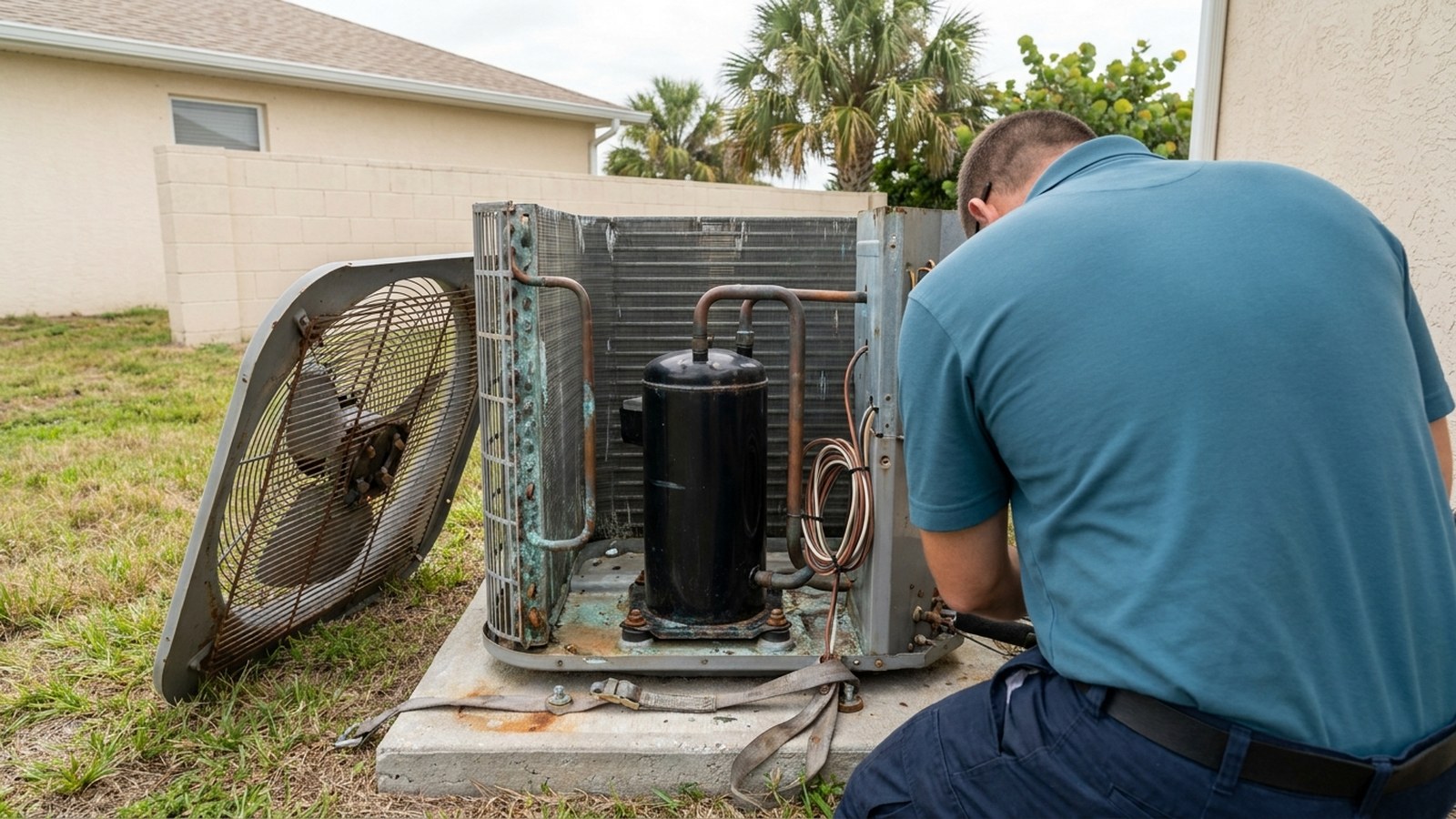
HVAC compressor replacement cost in Englewood depends first on whether Florida law keeps the part under warranty. When coverage applies, the manufacturer supplies the compressor, while the homeowner still pays labor and refrigerant. Without coverage, all three hit the invoice. That’s why the same compressor failure can produce very different quotes.
What drives HVAC compressor replacement cost in Englewood
The brand on the cabinet barely moves this number. What moves it is whether the manufacturer still owes you the part.
A compressor or coil replacement runs into the thousands. That’s true, and it’s also the least useful sentence anyone can tell you, because it says nothing about who pays which piece. Two different parties bill you on this job, and they bill for different things.
When parts coverage is live, the manufacturer supplies the compressor itself. The contractor who takes the call still bills for the diagnosis, the labor, and the refrigerant. When coverage is gone, all three land on you.
That’s the whole reason a national average won’t help you here. An average can’t see your installation date, your certificate, or whether the house changed hands, and it certainly can’t see Florida’s warranty statutes.
For scale, most AC repairs in Englewood run $150 to $650 for parts and labor once the diagnostic is done, and the diagnostic itself runs $89 to $150. A compressor sits well outside that pattern. It’s the most expensive single part in the system, and reaching it means opening the refrigerant circuit. At the other end sits full replacement, which runs $5,500 to $12,000 installed for most single-family homes. That’s your comparison point, not your compressor quote, and the AC installation page covers what that job involves.
The rule of thumb this site publishes is worth holding onto. If a compressor or coil quote costs more than half a new system, replacement is on the table, and the same goes for a system past 12 to 15 years old with a failing compressor or coil. That’s a starting point, not the decision. The AC replacement cost guide works through the rest of it.
Who pays for the part, and who pays for the labor
Where you sit on warranty splits the bill three ways.
| Warranty position | Compressor part | Labor and diagnosis | Refrigerant |
|---|---|---|---|
| Covered failure | Manufacturer supplies the covered part | Homeowner generally pays excluded contractor charges | Homeowner generally pays when the certificate excludes it |
| Coverage denied under an exclusion | Homeowner pays | Homeowner pays | Homeowner pays |
| Warranty expired | Homeowner pays | Homeowner pays | Homeowner pays |
That table doesn’t decide your claim. Your certificate, your installation record, and the manufacturer’s written decision do.
What it does show is why two neighbors with the same failure get very different totals. The work is nearly identical. Only one of them has a part being shipped for free.
Refrigerant deserves its own line here. A compressor swap means recovering the charge and putting a new one in, so refrigerant isn’t a footnote on this job, it’s a real number on the invoice, and it’s commonly excluded from parts coverage.
So don’t take a quote that’s one combined figure. Ask for the diagnosis, the compressor, the labor, and the refrigerant broken out separately. Once they’re on separate lines, you can see who’s paying for what.
The pros we send can open the system, find the failure, and document it. They can’t rewrite a manufacturer’s certificate or promise you a claim gets approved. Englewood Air Pro is a referral service, not the contractor doing the work.
Florida stopped registration from controlling warranty length
Warranty certificates have long worked the same way: register the system shortly after installation or the term drops, often by half. In Florida that stopped being enforceable on July 1, 2024, and a certificate printed for a national market won’t be the thing that tells you so.
Florida Statutes section 559.957(3) says: “Any offered manufacturer’s, distributor’s, or retailer’s warranty of an HVAC system or a component of the system may not be in any way conditioned upon the product registration.”
Section 559.957(1) includes an important installer condition:
“The full length of a manufacturer’s, distributor’s, or retailer’s warranty of a heating, ventilation, and air-conditioning (HVAC) system or any component of the system is effective in this state on the date of installation if installed by a contractor licensed under part I of chapter 489.”
The registration card must also carry a clear warning. Section 559.957(2)(b) says: “Failure to complete and return the card or form does not diminish any warranty rights or decrease the warranty length.”
Read that carefully, because it doesn’t mean every compressor failure gets covered. It means registration can’t be what shortens your term here. The licensed-installer condition still applies, and so does every exclusion in the certificate. Pull your certificate and your installation record together, then ask the manufacturer and your contractor to confirm in writing how Florida law lands on your system.
Carrier’s current certificate for R-454B condensing units shows exactly what the statute is aimed at. Its compressor row prints 10 years for the original owner and five for subsequent owners.
The certificate adds this registration footnote: “If properly registered within 90 days of original installation, otherwise 5 years (except in California and Quebec and other jurisdictions that prohibit warranty benefits conditioned on registration).”
Florida became one of those jurisdictions on July 1, 2024, and the certificate’s subsequent-owner footnote points at state law for the same reason. The 90-day rule is real, it’s printed, and here it doesn’t decide your term. Check your own certificate and installation history rather than a summary of somebody else’s.
Who did the installing matters too. The guide to licensed AC repair in Florida covers why compressor work isn’t handyman work, and the statute’s licensed-contractor condition is the same line drawn from the warranty side.
What happens when the house changes hands
This is the part that matters most around here, because so much of our housing stock was bought from somebody else. A home in Englewood, Rotonda West, Placida, Cape Haze or Boca Grande very often came with a system installed for the previous owner. Under the old certificates, closing day cut that ten-year term to five.
Florida Statutes section 559.956(1) now covers residential property with an HVAC system as a fixture that “is conveyed to a new owner on or after July 1, 2024.” A manufacturer’s warranty still in effect on that system “Is automatically transferred to the new owner; and” “Continues in effect as if the new owner was the original purchaser of such system or component, as applicable.”
The manufacturer can’t charge you for the handoff either. Section 559.956(2) says a warrantor “continues to be obligated under the terms of a manufacturer’s warranty agreement for a warranty transferred under this section and may not charge a fee for the transfer of the warranty.”
One limit worth knowing before you get your hopes up. Section 559.956(3): “The transfer of a manufacturer’s warranty under this section does not extend the remaining term of the warranty.” Buying the house doesn’t start a fresh ten years. It carries forward whatever’s left of the original term.
If you bought recently, start with your closing date, then track down the system’s installation date, model, serial number and certificate. Ask the manufacturer to put the remaining term in writing before anyone quotes you a compressor.
None of that guarantees a particular failure qualifies. It just means the term probably didn’t die at closing the way you were told, and that’s worth checking on a part this expensive. Homeowners in Rotonda West and out on Placida should run the same check.
The exclusions that decide a coastal claim
A live parts warranty still isn’t a promise the claim gets paid. What the manufacturer writes down as the cause of failure can decide the whole thing.
Start with the two exclusions that shape the invoice. Carrier’s certificate rules out “Labor or other costs incurred for diagnosing, repairing, removing, installing, shipping, servicing or handling of either defective parts, or replacement parts, or new units.” It separately rules out “Any cost to replace, refill or dispose of refrigerant, including the cost of refrigerant.”
Neither Florida statute touches either one. Nothing in 559.956 or 559.957 turns parts coverage into labor coverage, and nothing in them pays for refrigerant. The certificate still governs those lines, which is why a covered compressor is a smaller bill, not a free one.
Then there’s the exclusion written for somewhere else that lands squarely on us. Carrier excludes failure or damage due to “floods, winds, fires, lightning, accidents, corrosive environments or other conditions beyond the control of Company.”
Read that list again with Englewood in mind. Salt air, summer lightning and storm surge are three of our most common causes of equipment failure, and all three sit inside that sentence. A homeowner on Manasota Key can hold a live ten-year parts warranty and still be told the cause falls outside it.
That’s not a reason to panic, it’s a reason to document. Don’t guess at the cause from how the outdoor cabinet looks. Ask the contractor to write down the failed component and the damage they actually observed, then hold that against whatever the manufacturer puts in its decision.
Our guide to salt-air AC protection on the barrier islands covers the maintenance side of that problem. If your system keeps cutting its own power, the guide to an AC repeatedly tripping its breaker explains what a struggling compressor looks like electrically, and it’s worth reading before you reset the breaker again. For anything urgent, the emergency HVAC service page covers what shouldn’t wait until morning.
One more boundary. If the tech finds a refrigerant leak rather than a dead compressor, that’s a different job with different federal rules attached, and the guide to AC refrigerant leak repair cost covers it.
How to find where you stand before the quote
Get your records together before you start comparing compressor estimates. It’s an hour of digging that can change the number on the invoice.
- Find the outdoor unit’s model and serial number.
- Locate the installation invoice and warranty certificate.
- Confirm the original installation date and contractor.
- Record any property conveyance date after July 1, 2024.
- Ask the manufacturer to state remaining parts coverage.
- Request the coverage decision and exclusions in writing.
- Get an itemized contractor quote before authorizing work.
The quote should break out the compressor, the diagnosis, the labor, the refrigerant and the materials, and it should say plainly whether the compressor is being supplied by the manufacturer.
If the manufacturer denies the claim, ask which provision of the certificate they’re relying on. A phone summary leaves you nowhere. The written provision lets you check it against the statutes above.
Two traps to sidestep. Registration is no longer the conversation in Florida, but the licensed-installer condition and the exclusions haven’t gone anywhere. And a house that changed hands after July 1, 2024 doesn’t automatically mean the coverage is gone, though it also doesn’t mean the clock restarted.
While the tech is out, it’s worth asking whether anything else in the system contributed to the failure. That can change the scope of the work even when it changes nothing about the warranty.
For everyday diagnosis, see the AC repair service page. For keeping the next compressor alive longer, HVAC maintenance is the honest lever, especially this close to the water.
Call Englewood Air Pro at (941) 292-6250 when you’re ready. We’ll match your request with a licensed local HVAC contractor who can inspect the system and provide the actual quote.
Frequently asked questions
What is HVAC compressor replacement cost in Englewood?
A compressor or coil replacement runs into the thousands, but there isn’t one reliable total. Parts coverage, labor, refrigerant, and the documented failure cause determine the invoice.
Does an unregistered HVAC warranty still apply in Florida?
Florida law says an offered HVAC warranty can’t be conditioned on product registration. The full term applies from installation when a properly licensed contractor installed the system.
Does an HVAC warranty transfer when I buy a Florida home?
An existing manufacturer’s warranty automatically transfers with qualifying residential property conveyed on or after July 1, 2024. The transfer doesn’t restart the remaining warranty term.
Does a compressor warranty cover labor and refrigerant?
Not necessarily. Carrier’s current certificate excludes labor, diagnosis, installation, and refrigerant costs. Check your own manufacturer’s certificate because its exact terms control your claim.
Can coastal damage affect compressor warranty coverage?
It can under some certificates. Carrier excludes damage from floods, winds, lightning, and corrosive environments, so the contractor’s documented cause matters for an Englewood claim.