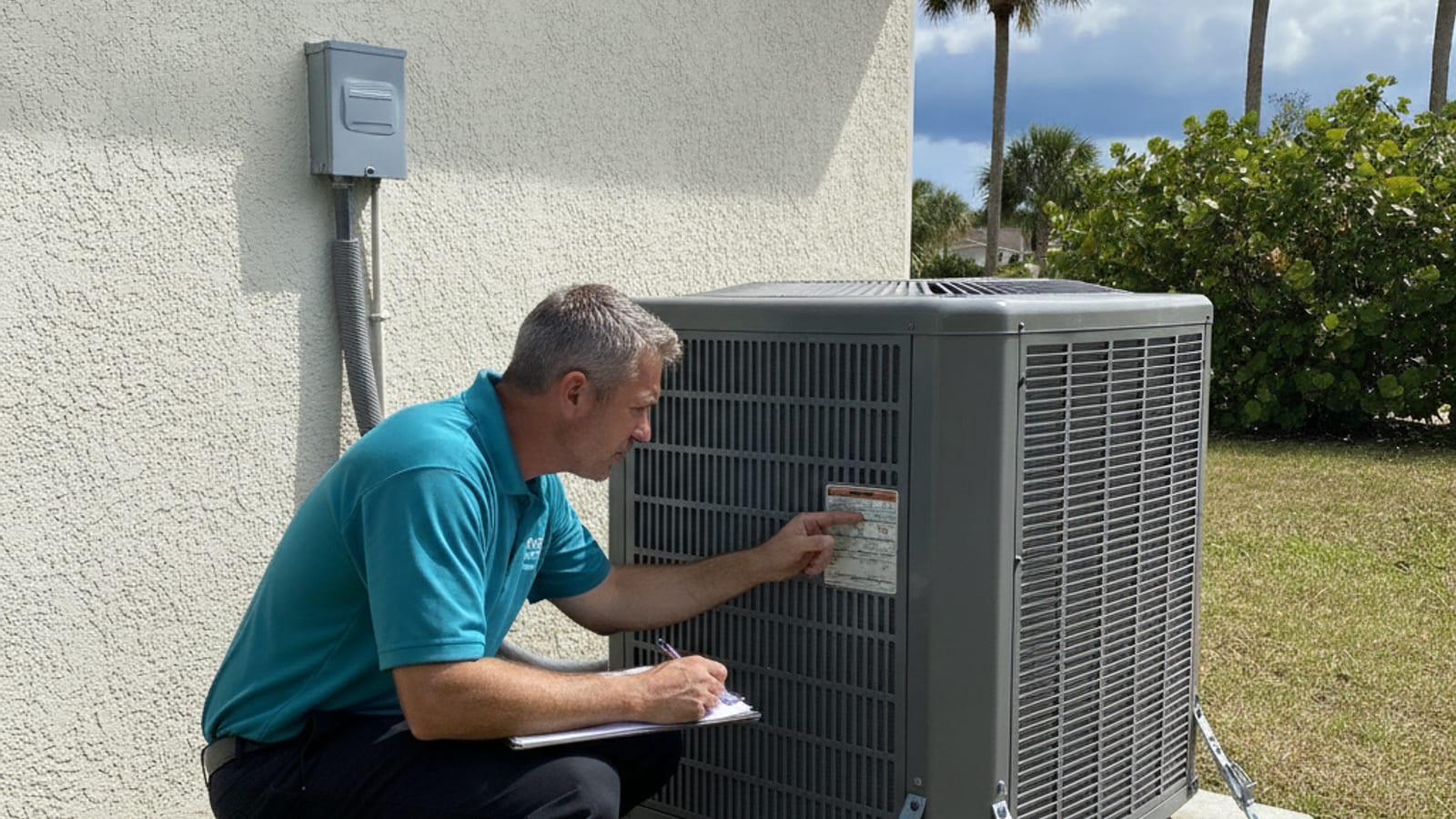
When your AC keeps tripping the breaker, the most useful thing you can do is watch the clock, not the equipment. A breaker that trips repeatedly is doing its job, and the moment it trips tells a technician where to start looking. Reset it once. If it trips again, leave it off and call. Everything below is about reading that timing, and about the one number printed on your own outdoor unit that settles the “just put in a bigger breaker” argument for good.
What should you do first when your AC keeps tripping the breaker?
Reset it once at most, then leave it off if it trips again.
Don’t open the outdoor disconnect, pull an equipment panel, or put a meter on anything. Never try to test or discharge a capacitor yourself. Those steps put your hands next to live 240-volt components.
Keep your distance from the outdoor unit and just look. If the disconnect box on the wall looks discolored or feels warm, stay away from it. That’s an electrical issue at the unit, not a job for DIY troubleshooting.
Then note exactly when the breaker trips. That one observation narrows the search more than any guess about which part failed.
| When the breaker trips | What that timing points toward | Your next step |
|---|---|---|
| Immediately after one reset | An electrical fault inside the unit | Stop resetting it |
| As the compressor starts | A compressor, fan motor, capacitor, or wiring problem | Leave the system off |
| After the system runs a while | Equipment that needs testing under its operating load | Schedule a diagnostic |
| During or after a storm | A grid surge that may have damaged a control board | Keep the system off |
A tripped breaker that won’t reset qualifies for 24/7 emergency HVAC service. Don’t keep cycling the breaker while waiting for help.
What does an immediate breaker trip mean?
An immediate trip usually points toward an electrical fault inside the unit.
This pattern matters most when the system never gets going at all. The rule we give every Englewood caller is the same one: if it trips the moment you reset it, stop resetting it and call.
That advice protects both you and the equipment. Repeated resets don’t identify the fault. They only send power back toward a system that has already rejected it. If the trip comes with a burning smell from the air conditioner, leave the breaker off and treat it as an emergency.
Tell the dispatched technician that the trip happens instantly. Mention whether the thermostat was calling for cooling at that moment. Don’t open the disconnect or cabinet to gather more information.
This page covers an AC that cannot remain powered. If your system runs but blows warm air, use the separate guide to an AC running but not cooling. That problem has a different diagnostic path.
Why does the breaker trip as the compressor starts?
A startup trip usually means the compressor or fan motor is pulling far more current than it should.
A failed capacitor is the common reason, since it forces the motor to work harder just to get going. A run capacitor wears down gradually under nine months of near-continuous run time, which is what an Englewood summer asks of one. Wiring or a bad electrical connection can do the same thing. Timing gives direction here, not a verdict.
Describe it to the dispatcher the way you saw it: the indoor blower starts, the outdoor unit tries to start, and the breaker goes. That sequence is worth more than a guess about which part died.
It also keeps you from paying for parts nobody proved were bad. A capacitor, a motor, a compressor and a wiring fault each need a different test, and the readings have to come off the circuit while it’s trying to run.
Coastal homes get one extra suspect. Salt air accelerates corrosion at electrical connections near Manasota Key and Boca Grande, so a connection that looked fine two seasons ago may not be. Our guide to protecting AC equipment from salt air covers that exposure in more detail.
Living near the water doesn’t prove corrosion caused your trip. It just tells the tech where to look first.
What does a trip after several minutes mean?
A delayed trip has to be tested while the system is running under load, which is the one thing a homeowner can’t do safely.
The usual suspects are a failing compressor drawing too much current, or a short in the condenser wiring. Timing alone can’t tell those two apart.
Don’t read anything into how many minutes it ran. That number only matters to someone with a meter on the circuit and the training to open the equipment. Your job ends at watching the sequence.
Write down three details before calling:
- Whether the indoor equipment started normally.
- Whether the outdoor unit started before power stopped.
- Whether the trip happened at roughly the same point twice.
Don’t create a third test by resetting the breaker again. Two matching observations are already enough to report a repeated problem.
A licensed pro can put the system on a meter through AC repair in Englewood. A diagnostic visit runs $89 to $150. The assigned provider sets the final price, and their written quote is the one that counts.
The Englewood AC repair cost guide explains how diagnostic and repair charges differ.
Why does the AC trip during or after a storm?
Lightning doesn’t have to hit your house to take out your AC.
A nearby strike on a power line or transformer sends a surge through the grid into your home, frying the AC’s control board even though the rest of the house seems fine. That’s why storm-season trips often show up with no other symptom.
Don’t walk up to the condenser right after a storm. Keep away from standing water, damaged wiring, and any electrical equipment that looks scorched or discolored. If the breaker won’t hold on one reset, leave it off.
Give the outdoor disconnect a look from a safe distance too. If it feels warm or shows any discoloration, that’s an electrical issue at the unit, not a job for DIY troubleshooting. Don’t open that box.
Power strips inside the house don’t protect the outdoor condenser. Surge protection at the condenser is the fix, not just power strips inside. A licensed provider can walk you through what fits your system.
Read the emergency AC guidance after a storm before deciding whether the situation can wait.
What can the outdoor rating plate tell you?
The rating plate tells you what the manufacturer says this circuit is allowed to be.
It’s a printed label on the outside of the outdoor cabinet, so you can read it without opening anything. Look for two rows by their literal names: “Minimum Circuit Ampacity” and “Max. Overcurrent Protection.” Don’t guess either number from how big the unit looks.
Goodman’s installation instructions put it plainly: “The condensing unit rating plate lists pertinent electrical data necessary for proper electrical service and overcurrent protection.”
Goodman’s own GSXN4 specification table shows how much these numbers move between models. Across the seven sizes listed there, minimum circuit ampacity runs from 8.3 to 33.3 amps and max. overcurrent protection runs from 15 to 50 amps.
Those are that one product family’s figures, not yours. They don’t tell you your equipment’s values and they don’t tell you which breaker belongs on your circuit. The number you want is printed on your own cabinet.
Photograph the whole plate from where you’re standing and send it to whoever takes your call. Don’t pull a panel to reach a label that’s awkward to see.
The model and electrical rows let the technician show up prepared. They don’t replace testing the circuit.
Why isn’t a bigger breaker the fix?
Putting in a bigger breaker isn’t a repair. It’s a way to stop being told about the problem.
The manufacturer sets both the size of the protection and the type of device, and the two travel together. Change either one without following the equipment documentation and you’ve hidden the fault rather than found it.
Goodman’s GSXN4 specification sheet is explicit: “Must use time-delay fuses or HACR-type circuit breakers of the same size as noted.”
The matching installation instructions say those approved devices “have sufficient time delay to permit the motor-compressor to start and accelerate its load.” Read that carefully. It means the specified breaker already allows for the startup surge. It does not mean a breaker that keeps tripping is just being fussy about startup.
So a plain breaker off the shelf isn’t automatically a substitute either. What’s listed on the plate is what belongs there, and a technician should compare the breaker that’s actually installed against it.
Don’t swap the breaker, size it up, or open the electrical panel yourself. Hand the plate photo and the timing pattern to the pro who shows up.
Who should handle an AC that keeps losing power?
A licensed HVAC pro, with a meter on the circuit, is the only honest answer to a breaker that keeps letting go.
Englewood Air Pro is a referral service, not the contractor doing the work. We connect Sarasota and Charlotte county homeowners with independently owned, licensed and insured local HVAC providers, and the pros we send carry their own license and insurance. You can check any Florida CAC license for free at myfloridalicense.com before work starts, and we’d rather you check than take anyone’s word for it. Repair work like this is also where handyman AC repair runs out of legal room in Florida, which is one more reason to check.
Standard hours run Monday through Saturday, 7 a.m. to 7 p.m., and emergency service is available 24/7 across both counties.
Once the fault itself is fixed, ask the provider whether HVAC maintenance or an AC tune-up makes sense for your system. Those catch a drifting capacitor reading long before it becomes a breaker that won’t hold.
Frequently asked questions
Can I reset an AC breaker once?
Yes, you can reset it once before stopping. If it trips immediately or trips again, leave it off. Don’t keep testing a circuit that repeatedly cuts power.
Why does my breaker trip when the compressor starts?
The compressor or fan motor may be drawing far more current than it should. A failed capacitor can also force a motor to work harder just to start. A short in the condenser wiring is the other common cause, and all three need professional testing to tell apart.
Can I install a bigger breaker for my AC?
No, a bigger breaker isn’t a valid repair for repeated trips. The outdoor rating plate and manufacturer instructions identify the proper protection. A licensed professional should compare those requirements with the installed circuit.
Where can I find my AC’s electrical information?
Look for the rating plate on the outdoor cabinet. Find “Minimum Circuit Ampacity” and “Max. Overcurrent Protection.” Read or photograph the label without removing any equipment panel.
Can lightning make my AC trip its breaker?
Yes, a nearby strike can send a surge through the grid. That surge may damage the AC control board without directly striking your house. Leave the system off if the breaker won’t reset once.
Is a repeatedly tripping AC breaker an emergency?
Yes, a tripped breaker that won’t reset qualifies for emergency service. Englewood Air Pro runs 24/7 referral service across Sarasota and Charlotte counties, so it doesn’t have to wait until Monday.
If your AC keeps tripping the breaker, note when it trips, leave it off, and call (941) 292-6250. We’ll connect you with a local HVAC pro who can put a meter on it.