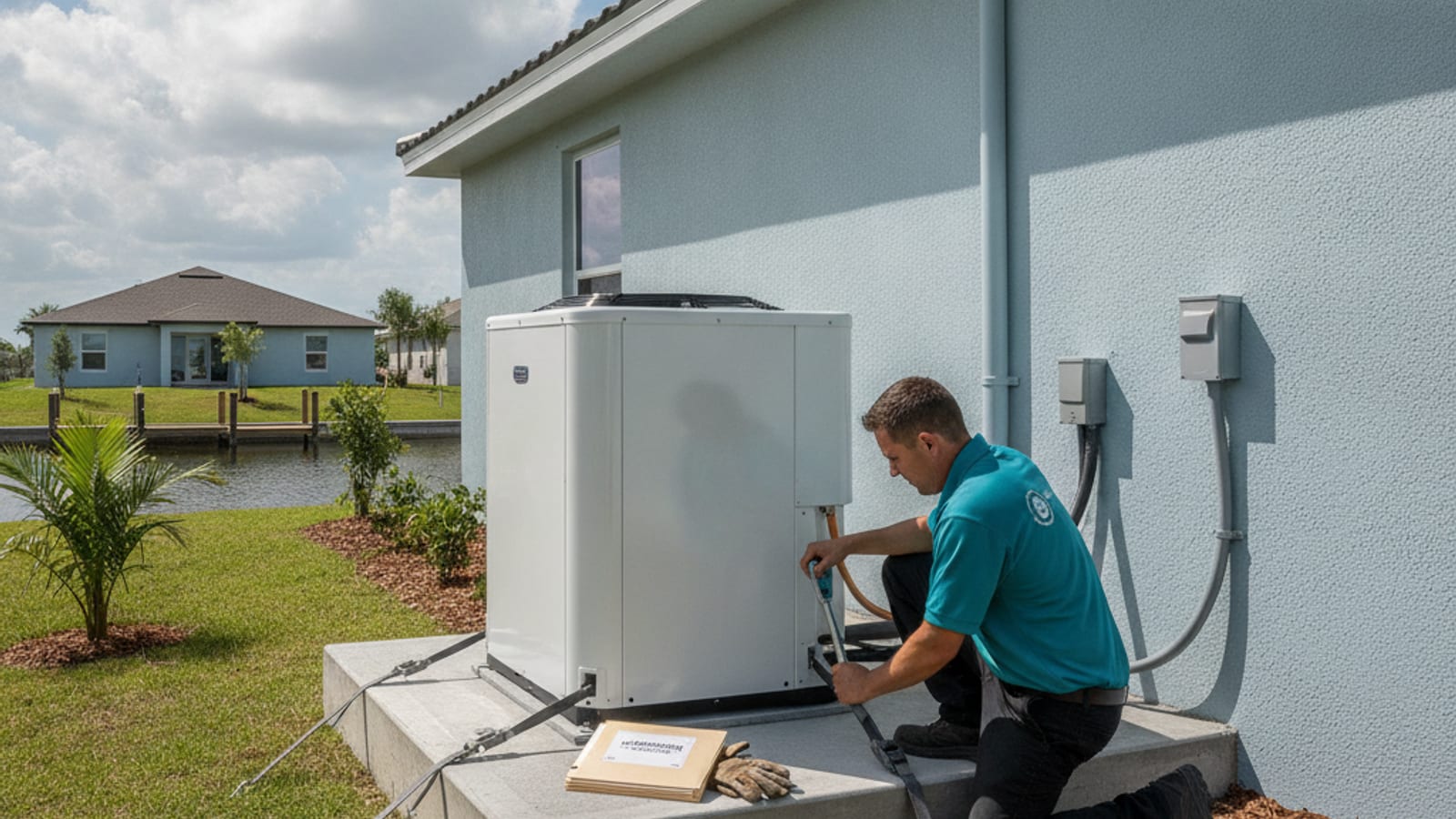
Hurricane Ian made landfall near Cayo Costa as a Category 4 storm in September 2022, and the eye passed almost directly over Charlotte Harbor. Four years later, HVAC crews working the Englewood, Port Charlotte, and Punta Gorda corridor are still pulling condensers that trace their failure back to that storm. The damage wasn’t always obvious in the first year, so a lot of it surfaces on a slower timeline than most homeowners expect.
Why replacements are still happening years later
Storm surge and wind-driven rain got into places that weren’t visibly damaged in September 2022. A condenser that took on saltwater spray or debris impact might have run fine for a year or two before corrosion worked through a coil or a compressor started drawing higher amperage than it should. Insurance adjusters and HVAC techs both see this pattern often in this market: equipment that survived the storm on paper is quietly failing on borrowed time.
Homes in Punta Gorda Isles and along the Peace River saw some of the heaviest surge in the metro, and canal-front condensers there took direct saltwater exposure that inland units in Englewood never saw. Port Charlotte’s older General Development Corporation-platted neighborhoods had a mix of storm and wind damage spread across a huge footprint, so replacement volume there has stayed elevated longer just because there’s so much housing stock to work through.
What a 4-point inspection actually flags
Florida insurers require a 4-point inspection on older homes at renewal, and HVAC is one of the four systems reviewed alongside roof, plumbing, and electrical. An inspector documents the age, condition, and visible wear on the outdoor condenser and indoor air handler. A unit that’s rusted through at the base pan, missing panels, or running an obsolete refrigerant type gets flagged, and that flag can affect renewal terms.
For plenty of Englewood-area homeowners, a flagged inspection is the actual trigger for finally replacing a system that’s been running rough since the storm. It’s a paperwork problem with a mechanical root cause, and the fix is the same either way: a documented, professionally installed AC replacement with a paper trail an adjuster can review.
Insurance-driven replacement patterns
Claims from Hurricane Ian created a pattern in this market that’s different from a routine end-of-life system swap. A homeowner files a claim for storm damage, the adjuster assesses covered losses, and HVAC replacement gets bundled into a broader restoration scope alongside roofing and window work. That bundling means AC replacement timing in this metro often isn’t driven by the equipment’s actual age. It’s driven by when the claim settles and when a contractor crew can get on-site.
This has created real backlogs. Roofing and general contractors have been booked out for extended stretches since 2022, and HVAC work sequenced behind roof-tear-off or exterior repairs sometimes waits months for its slot. Homeowners doing a full storm restoration should ask their general contractor directly where HVAC falls in the sequence, since running a new system before roof work wraps can expose new equipment to the same water risk that damaged the original unit.
Generator transfer switches paired with new installs
A meaningful share of post-Ian replacement projects in this metro now include a whole-home or partial-home generator transfer switch installed alongside the new AC system. The logic is straightforward given what a lot of Englewood-area residents lived through in 2022: extended power outages that left homes without cooling for days in September heat, with humidity climbing fast inside a closed-up house.
Pairing an emergency HVAC plan with generator capacity matters more here than in most Florida markets, given how directly this metro sits in Gulf hurricane paths. A transfer switch sized to run at least the AC system and a few essential circuits keeps a home livable through outages that used to mean total shutdown. It’s a bigger upfront cost than a standalone AC swap, but for homeowners who lived through the 2022 outages, it’s often become a standard part of the project. If you’re deciding whether a generator to run AC is worth pairing with the replacement, that guide covers the startup numbers on your own rating plate and what the transfer switch add-on costs.
Why some systems are only failing now, in 2026
Corrosion is a slow process. A coil that took light saltwater exposure in September 2022 might run at reduced efficiency for a year or two before a refrigerant leak finally develops at a weak point. Compressors stressed by debris impact or electrical surge during the storm sometimes fail gradually rather than immediately, drawing more power and running hotter each season until they finally quit.
This is part of why HVAC crews across Port Charlotte and Punta Gorda are still fielding storm-linked replacement calls well past the storm’s anniversary. A system that looked fine on a 2023 walkthrough can still be a 2026 replacement, and homeowners are often surprised the storm connection even exists this many years out.
What a realistic replacement budget looks like
Costs vary by system size and equipment tier, but homeowners planning a storm-linked replacement should budget for more than just the AC unit itself. A canal-front or barrier-island property often needs coastal-rated equipment, discussed in more depth in our post on salt air corrosion protection, which carries a real premium over standard residential equipment. Add a generator transfer switch to the project and the total climbs further, though many homeowners split that into a separate phase rather than committing to both at once.
Get itemized quotes that separate the AC replacement cost from any electrical or generator work, and ask whether the quote assumes standard or coastal-rated equipment. A quote that looks lower than a competitor’s sometimes reflects standard equipment that won’t hold up as long this close to the Gulf, which matters when comparing bids for a storm-restoration project where you want the replacement to actually outlast the next major storm cycle.
Right-sizing a replacement after storm-driven remodeling
A number of post-Ian restoration projects went beyond a like-for-like rebuild. Homeowners who gutted flooded rooms sometimes reconfigured floor plans, added or removed interior walls, or changed window placement during the repair process. Any of those changes can shift a home’s actual cooling load enough that simply replacing the old AC system with an identical-capacity unit misses the mark.
If your home went through any structural changes during storm repair, mention that directly to whoever quotes your AC replacement rather than assuming the old system’s tonnage is still correct. A proper load calculation accounts for the home’s current configuration, not its pre-storm layout, and getting the sizing right matters more for humidity control in this climate than most homeowners realize going in.
What to check before assuming storm damage is behind a failure
Not every AC problem in this metro traces back to Hurricane Ian at this point. Plenty of systems are simply reaching normal end-of-life on their own schedule. But for homes that had any storm exposure in 2022, especially anything within a few blocks of the harbor, canals, or Gulf-facing streets, it’s worth mentioning the storm history to whoever diagnoses a failing system. Corrosion patterns and compressor wear consistent with saltwater exposure look different from routine age-related failure, and that distinction can matter for an insurance claim.
Always verify a contractor’s CAC license directly at myfloridalicense.com before any major replacement work begins, particularly for projects tied to an active insurance claim where documentation quality matters.
Is Hurricane Ian damage still covered on a 2026 AC claim?
Coverage depends on the specific policy and when the damage is documented, not on how much time has passed since the storm. Homeowners who suspect a current AC failure traces back to 2022 storm exposure should raise it directly with their insurer and get a professional diagnosis that documents the likely cause.
How do I know if my AC failure is storm-related or just old age?
A tech familiar with storm-pattern damage can usually tell the difference by looking at corrosion location, coil condition, and compressor wear patterns. Saltwater and debris damage tends to show up differently than routine age-related wear, especially around the base pan and lower coil sections.
Does a 4-point inspection require AC replacement automatically?
No. A flagged inspection means the system’s condition needs to be addressed, either through repair, professional confirmation it’s still serviceable, or replacement, depending on what the inspector documented and what the insurer requires.
Should I pair a generator transfer switch with a new AC install?
It depends on your risk tolerance and budget, but a meaningful number of Englewood-area homeowners who lived through extended 2022 outages now build it into their replacement project. It’s worth asking a contractor to quote both options separately so you can compare the real cost difference.
If you’re dealing with a system that’s been running rough since 2022 or you got flagged on a recent 4-point inspection, call (941) 292-6250 and we’ll connect you with a local HVAC pro who can diagnose it and walk you through what documentation your insurer will want to see.